Rameen Masood, Leicester
Empowerment. It’s a word thrown around in the news and all around us far too often. It rolls effortlessly from the tongues of politicians and world leaders, each promising sweeping reform and brighter futures, yet all too frequently leaving behind little more than meticulously crafted speeches. In an age that prides itself on progress, one can’t help but wonder whether society, despite its confident proclamations, is gradually edging towards something more draconian, where liberty is loudly advertised but increasingly hollow in substance.
So, it implores the question is empowerment merely the freedom to choose? Is it the ability to pursue an education or a career? Is it financial independence? These undoubtedly form part of the picture, yet they remain incomplete, for they concern only the outward life. I believe that empowerment extends much deeper. It’s cultivated patiently and with sincere care until it becomes so profoundly rooted that no tempest can uproot it.
The Second Caliph of the Ahmadiyya Muslim Community, Hazrat Mirza Bashir-ud-Deen Mahmood Ahmad (may Allah be pleased with him) once said: ‘You have someone who has true sympathy for you; who truly loves you; who considers your pain and sufferings to be his own; and who is always praying to Allah for you.’ [1]
For me, that nurturing hand has always been the hand of Khilafat.
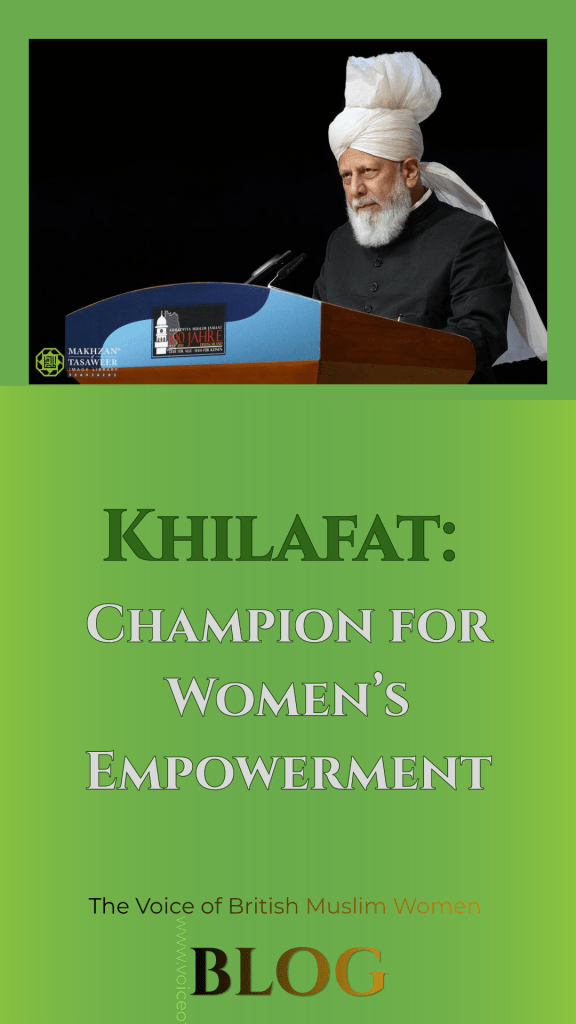
I was born and have grown under the blessed shade of the Fifth Caliph, Hazrat Mirza Masroor Ahmad (may Allah be his Helper). To me, His Holiness is a role model in every facet of life. From academic aspirations and professional ambitions, to navigating the overwhelming currents of the modern world, particularly the vast and often turbulent landscape of social media, Khilafat stands with us strong.
How many statistics surround us today revealing the struggles women continue to face? How many voices remain unheard and how many aspirations remain unrealised because women have been denied opportunities that should have been theirs? Yet, within the blessed institution of Khilafat, Ahmadi Muslim women are continuously reminded of both their responsibilities and their extraordinary potential. The rights granted to women by Islam are not merely preserved within the pages of antiquity; rather they’re brought to life. Khilafat teaches us how we can make our lives and existence useful.
And I don’t say this superficially as I’ve witnessed this personally and breathed its impact in my own life.
Just under a year ago, I had the blessed opportunity of a mulaqat (audience) with beloved Huzoor (may Allah be his Helper), during which I sought his guidance regarding a research project exploring the therapeutic potential of honey. Huzoor (may Allah be his Helper) very lovingly encouraged me to pursue this field of research, to use the Holy Qur’an as my guiding light, and even suggested a contact of one of the senior researchers in the field.
I often find myself reflecting upon how feeble I am, yet here is the Khalifa of the time, the spiritual leader of millions, taking a personal interest in my aspirations and sincerely wishing to see me flourish into the best version of myself. There are countless examples like this, chronicles that span generations and could fill volumes, each one bearing testament to this unique relation. The world often portrays Muslim women as oppressed, yet I proclaim loud and clear that I’m empowered through the teachings of Islam and through the blessed guidance of the man of God on earth.
Regarding the potential of women, the Second Caliph (may Allah be pleased with him) beautifully wrote: ‘Women can converse with God Almighty in the same way men can. Women can guide the world in the same way men do. Women can also rid the world of ills in the same way as men. There is no difference between women and men in religious matters. Women, like men, can also serve their faith. Thus, bear this well in mind, that God Almighty has bestowed both men and women with similar capabilities. If men can attain perfection and reach God Almighty, then so too can women. If men can preach, so too can women. If men can lead and guide humanity, women can also.’ [2]
By Allah, Khalifa-e-Waqt (the Caliph of the time) has so much love and care for us that I doubt any word exists in the English dictionary to express it adequately. I’m merely one girl amongst millions who have been, and will continue to be, empowered through the blessed institution of Khilafat, God Willing. Through the guidance and prayers of Khilafat, these pious daughters of Jama’at Ahmadiyya will grow into women who serve humanity through their various professions, nurture generations with righteousness, and become mothers beneath whom paradise truly lies.
Even as I write these words, I know I can never wholly do justice to the pain and love beloved Huzoor (may Allah be his Helper) feels for us. I’m left only with a heart brimming with gratitude and the following Quranic words on my lips: ‘Which, then, of the favours of your Lord will you twain deny, O men and Jinn?’ [3]
We’re all leaves and to prosper, we must stay firmly attached to the tree of Khilafat, otherwise we’ll find ourselves adrift in the breeze, lost and forlorn.
I would like to end on these words of beloved Huzoor (aba): ‘May it be that history bears witness to the fact that Ahmadi Muslim women were at the vanguard of establishing the Oneness of God in the world.’ [4]
References
[1] Blessings of Khilafat, pg. 6
[2] Flowers for the Women Wearing Veils, Vol I, pg. 16
[3] The Holy Qur’an with English Translation by Maulawi Sher Ali, Chapter 55 Verse


Leave a comment