Syeda Ahmad, Hampshire
The writings of the Promised Messiah (peace be on him) are like a chest of pearls, and a single page from one of his books shines with fragments of wisdom that would have taken years of searching to uncover oneself; there is one particular passage from his book The Philosophy of the Teachings of Islam, written in 1896, that I find myself returning to often. It is a portion in which he discusses the connection between one’s mind and one’s body: “Physical conditions deeply affect the soul,” he wrote, “For instance, when our eyes are filled with tears, even if the tears are artificially induced, the heart is immediately affected and becomes sorrowful. In the same way, when we begin to laugh, even if the laughter is artificially induced, the heart begins to feel cheerful.” This is a principle, he says, that is found throughout the teachings of Islam, and is one of the reasons that Islamic teachings include guidelines on the proper manner of eating and drinking, or of personal hygiene: “according to the Holy Quran the natural state of man has a very strong relationship with his moral and spiritual states, so much so that even a person’s manner of eating and drinking affects his moral and spiritual states.”1
I find this connection, between our bodies and minds, to be very interesting. There are times in my life where it has felt more like my mental and physical forms are working against each other, as opposed to in tandem; instances of prolonged illness as a child, for example, or a bad bout of insomnia as a young adult. Anyone who has experienced illness, from a flu to something more chronic, knows of the frustration of feeling as though you are a mind trapped inside a body. Virginia Woolf wrote about this in her essay “On Being Ill”: “All day, all night the body intervenes;… the creature within can only gaze through the pane—smudged or rosy; it cannot separate off from the body like the sheath of a knife or the pod of a pea for a single instant; it must go through the whole unending procession of changes, heat and cold, comfort and discomfort, hunger and satisfaction, health and illness.”2
As you may suspect, it is not really healthy to feel so separate from one’s own body. Psychologists and exercise enthusiasts alike expound the importance of connecting with your physical form, recommending exercises like yoga or pilates (Joseph Pilates, the inventor of the latter form of movement, once described it as “the complete coordination of mind, body and spirit”), in order to help regulate symptoms of stress and anxiety, as well as aiding digestion and sleep. The first time I started doing such exercises, I was galled by how simple tasks of coordination — raising my left leg and right arm at the same time while inhaling, then exhaling as I lowered them, for example — could leave me so stumped, picking up one wrong limb then another, checking the person next to me to figure out how to mimic the flow with which they were moving.
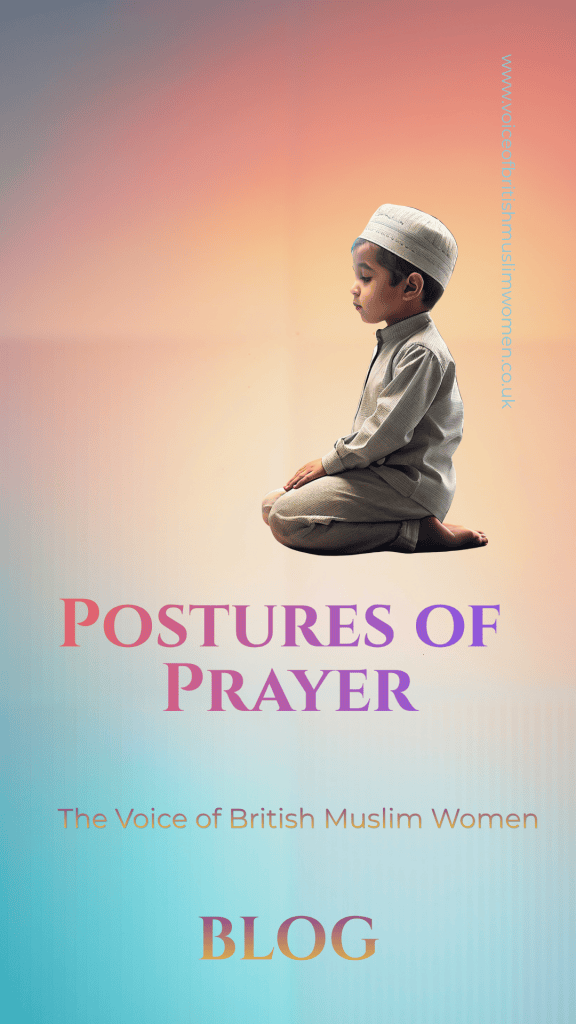
In Islam, the mind-body connection is encouraged in the act of Prayer. For the five daily Prayers, there are specific postures that go with each recited prayer. When we pray to be guided on the right path, we stand before God with our heads bowed; when we praise Him we bow, with our hands to our knees; when we are beseeching Him in our own language, we do so while fully prostrated. I realised, in one of those yoga classes, that the only other time I moved my body with such thought and intention, was whilst offering Prayer.
The Promised Messiah (peace be on him) has written about the wisdom behind the different postures of Islamic Prayer: “Man is required to stand in the presence of God Almighty and standing is also from among the etiquettes of servants. The bowing position, which is the second posture in prayer, demonstrates that one submits themselves by lowering their head in preparation to fulfil any command that may be given to them, as it were. Moreover, the prostration expresses, through action, the greatest possible reverence, utmost humility and lowliness, which are the objectives of prayer.”3
Prayer, in Islam, is not just a technique meant to connect our hearts to our bodies, or help us to relax after a long day (though it serves both of these purposes, along with many others). It is, in fact, the whole point of our existence. Whilst in other faiths people pray on their knees, or seated with their eyes closed, Islamic Prayer takes us through a cycle of motions, each change in posture helping us to deepen our connection to God, to the words we’re repeating and the prayers that are desperately escaping our hearts.


Leave a Reply