Allah Almighty says in the Holy Qur’an:
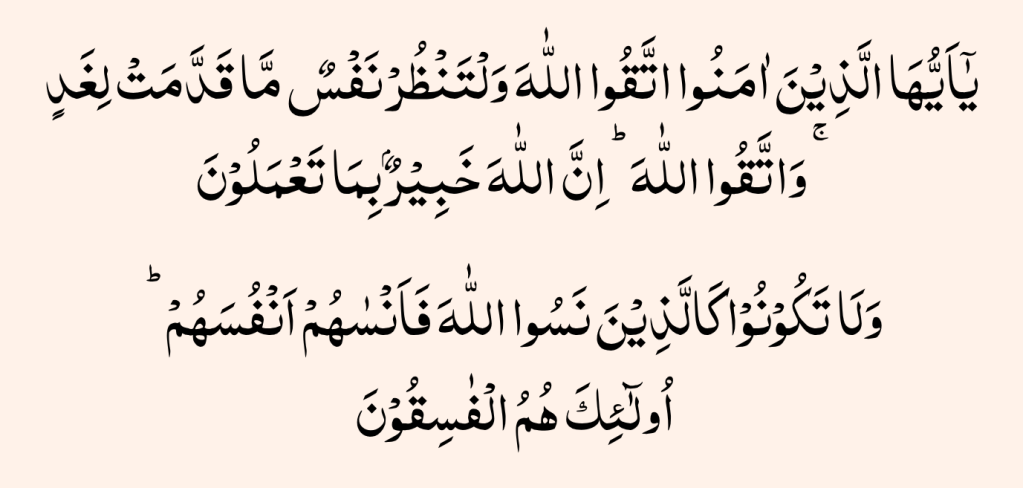
O ye who believe! fear Allah; and let every soul look to what it sends forth for the morrow. And fear Allah; verily Allah is Well-Aware of what you do.
And be not like those who forgot Allah, so He made them forget themselves. It is they that are the rebellious.”
(Surah Al-Hashr, 59:19–20)
Assalaamo Alaikum wa Rahmatullahi wa Barakatuhu, dear Nasirat and Lajna.
We can become very good at planning our worldly future. We think about our education, careers, homes, finances, families and retirement. There is nothing wrong with responsible planning. But the Holy Qur’an asks us to apply that same seriousness to our spiritual future.
What are we sending forth for tomorrow?
The root cause of sin often lies in gradually forgetting the standards expected of a believer. We stop making an effort to avoid certain weaknesses; our taqwa diminishes; and our belief in the Hereafter can slowly weaken.
Therefore, when Allah says, “let every soul look to what it sends forth for the morrow,” He reminds us that our main concern should not simply be the comforts and interests of this world. We should constantly be thinking about our relationship with Allah, the level of our faith and whether our behaviour reflects righteousness.
We need to instil within ourselves the belief that Allah sees every action. No deception is insignificant. No act of dishonesty becomes acceptable simply because nobody else knows about it.
Sometimes a person may avoid a worldly loss through deception or cheating and think they have gained something. But whatever worldly advantage has been gained, spiritually something far greater has been lost. Gradually, such behaviour distances a person from faith and from Allah.
Hazrat Khalifatul Masih I (may Allah be pleased with him) said that God has given us a principle to succeed in this world and the next and that is to be concerned for the next life. What this means is that if our focus is on the next life, success in this life will automatically follow.
If I asked you: what is the most dangerous disease in the world?
Is it COVID? Or maybe diabetes? Or perhaps even Cancer?
The Promised Messiah (peace be on him) warned that the most dangerous disease of the present is spiritual sickness. With a physical illness, symptoms often alert us that something is wrong and prompt us to seek medical treatment. But spiritual disease can develop silently.
A person may not even realise when laziness in worship, attachment to worldly things, pride, dishonesty or distance from Allah has entered the heart.
Sometimes our family or friends may even notice changes in us and advise us. But when spiritual illness progresses, rather than accepting sincere advice, a person may begin to think that everyone else is mistaken.
That is why prevention is so important. We need to take precautionary measures. A believer should never allow herself to be without taqwa – the fear and love of Allah.
Hazrat Musleh-e-Maud (may Allah be pleased with him) spoke beautifully about different stages of taqwa. He said:
“Taqwa is such a blessing that once a person attains it, he no longer cares for anything in the world in comparison with it.”
He then related something deeply personal about the Promised Messiah (peace be on him). He explained that he once saw the Promised Messiah’s (peace be on him) notebook. Whenever a pure thought or feeling arose within his heart, he would write it down.
Addressing Allah, the Promised Messiah (peace be on him) wrote:
“O my Lord! O my beloved Master! O my Beloved! O my Love, my God!… when neither my friends nor my enemies have any idea of the state I am in, it is then that You awaken me and lovingly say to me, ‘Do not grieve. I am with you.’ Then, O my Lord, how can it be possible that, despite such beneficence, I should leave You? Never, never!”
(Translated from Anwarul Aloom, Vol 1, pp. 375-376)
How beautiful is this relationship with Allah.
We speak to Allah in every Salat, but we should ask ourselves: when was the last time I truly spoke to Allah? When did I pour my heart out to Him? When did I address Him as my Friend, my Protector and my Beloved?
But Hazrat Musleh-e-Maud (may Allah be pleased with him) reminds us that this relationship does not develop overnight. Taqwa is not attained all at once.
Allah says:
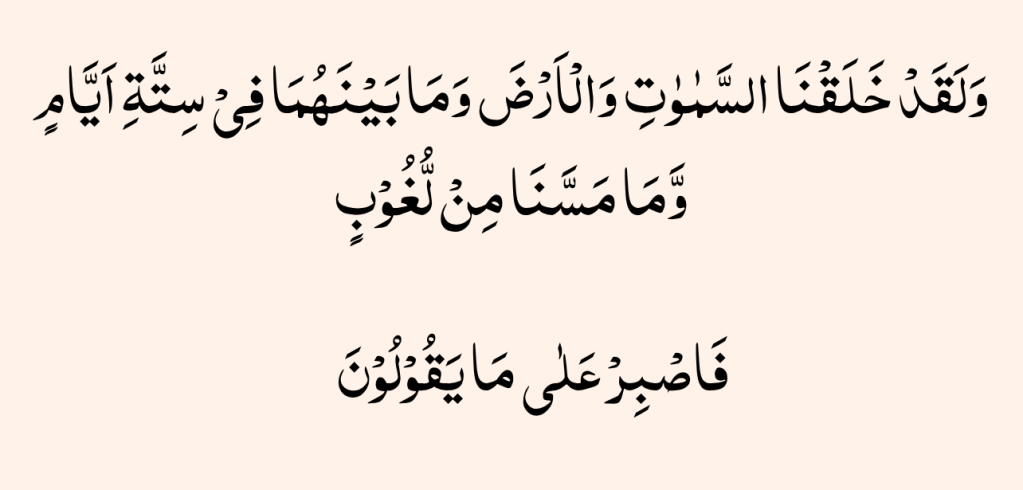
“And verily, We created the heavens and the earth and all that is between them in six periods, and no weariness touched Us.
So bear with patience what they say…”
(Surah Qaf, 50:39–40)
Hazrat Musleh-e-Maud (may Allah be pleased with him) explained that Allah is teaching us an extraordinary lesson. Allah could create instantly, yet He chose gradual stages. Therefore, why should we expect our own spiritual transformation to happen immediately?
Hazrat Musleh Maud said: I often see people become sceptical because of this very haste. As soon as they join [the Community], they say, “we took the pledge of allegiance, but why have we not experienced a spiritual vision of the Holy Prophet? Why have we not attained the spiritual ranks of the saints? Why have we suffered a loss in our business?” All such thoughts are corrupt.
If Allah Almighty does not break His laws even for the sake of the Holy Prophet (peace and blessings of Allah be upon him), then who are you that everything should happen immediately simply because you demand it? In short, everything takes place with patience.
(Translated from Anwarul Aloom, Vol 1, p. 376)
We might attend an Ijtema, listen to a speech, make a resolution and then become disappointed when we are not completely transformed the next morning.
Spiritual development requires patience, persistence and repeated effort.
Hazrat Musleh-e-Maud (may Allah be pleased with him) described three progressive stages of taqwa: patience and self-restraint, gratitude, and doing good to others.
The first stage is that of patience and self-restraint
It is to restrain ourselves from what Allah has forbidden.
Hazrat Musleh-e-Maud (may Allah be pleased with him) gave the example of a rider whose hungry horse is travelling along a road surrounded by fields. Naturally, the horse wants to eat the crops, but the rider pulls on the reins so that it does not damage someone else’s crops and thereby bring trouble upon itself.
(Adapted and translated from Anwarul Aloom, Vol 1, p. 377)
Our desires can be like that horse.
Something attracts us. We want to say something, watch something, buy something or respond angrily to someone. But taqwa means holding the reins of our own self and saying:
Allah would not be pleased with this, so I will stop.
Hazrat Musleh-e-Maud (may Allah be pleased with him) also explained that we are like guests of Allah in this world. A respectable guest does not enter the host’s home and simply take whatever they wish. Likewise, everything around us belongs ultimately to Allah. We have the right to use what He has permitted, but we should remain within the boundaries He has established.
(Adapted and translated from Anwarul Aloom, Vol 1, p. 377)
Patience also means remaining steadfast when something we love is taken away.
Allah says:
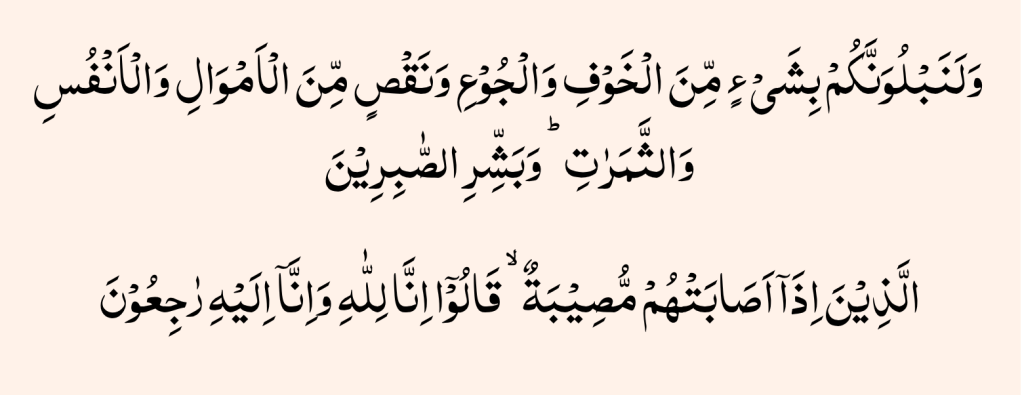
“And We will try you with something of fear and hunger, and loss of wealth and lives, and fruits; but give glad tidings to the patient.
Who, when a misfortune overtakes them, say, ‘Surely, to Allah we belong and to Him shall we return.’”
(Surah Al-Baqarah, 2:156–157)
The patient person recognises: It belonged to Allah, and Allah has taken back what was His. Anxiety would only make sense if something had actually been lost.
Hazrat Musleh-e-Maud (may Allah be pleased with him) gave a simple example. Imagine someone travelling to Qadian whose luggage is sent ahead from Batala railway station. It would be foolish for the traveller to panic because the luggage had gone ahead of him. He himself is travelling to the same destination.
Similarly, “Surely, to Allah we belong and to Him shall we return” reminds us that we all belong to Allah and ultimately return to Him.
Patience also means contentment: that a person should not become greedy for more than the beneficence and blessings that Allah Almighty has bestowed upon her.
The person who restrains from every kind of evil is called patient and God-fearing. This is the lowest degree [of taqwa].
(Adapted and translated from Anwarul Aloom, Vol 1, p. 378)
This is the first stage: self-restraint and patience.
The second stage is higher: gratitude
When difficulty comes, the patient person says: It belonged to Allah, and He has taken it back.
But the grateful person goes further.
She says: Yes, one blessing has been taken away – but look at everything Allah has still given me.
Instead of concentrating entirely on what has been lost, she remembers everything that remains.
Hazrat Musleh-e-Maud (may Allah be pleased with him) compared taqwa to climbing a mountain. One person faces every obstacle and refuses to turn back: that is patience. Another person not only endures every difficulty but somehow takes a step forward through it: that is gratitude.
The grateful person sees even the ability to worship Allah as a blessing.
A patient person performs Salat because Allah has commanded it.
A grateful person performs Salat and then thinks: O Allah, how great is Your favour that You enabled me to worship You.
A person may give chanda and think: I have fulfilled my obligation.
But the grateful person thinks: Alhamdulillah, Allah chose to accept this service from me.
(Adapted and translated from Anwarul Aloom, Vol 1, p. 379)
Maulana Rumi relates a beautiful story about Hazrat Luqman.
Hazrat Luqman was once given a slice of melon by his master, who loved him greatly. He ate it with apparent enjoyment, so his master gave him another slice, and then another.
Eventually his master tasted it himself – and discovered that the melon was extremely bitter.
He asked Hazrat Luqman why he had not complained.
Hazrat Luqman replied that for so long he had received sweet and pleasant things from his master’s hand that he would have been ungrateful if, after receiving one bitter thing from that same hand, he had complained.
(Adapted and translated from Anwarul Aloom, Vol 1, pp. 379-380)
Think of how many sweet things we have received from the hand of Allah.
Our faith. The Holy Qur’an. Khilafat. The Jama’at. Our families. Food. Shelter. Health. Friendship. Education. The ability to pray. Countless prayers answered in ways we may already have forgotten.
Yet when one bitter moment comes, how quickly can it fill our entire field of vision?
Gratitude means remembering the thousands of blessings surrounding that one difficulty.
The third stage: there is an even higher stage: the muhsin, the person who does good.
When hardship comes, the muhsin does not think only about herself. She thinks: There must be others suffering too. What can I do for them?
She does not merely remain patient. She does not merely thank Allah for what she has. Her own experience makes her more compassionate towards others.
Hazrat Musleh-e-Maud (may Alla be pleased with him) illustrated this through the Promised Messiah (peace be on him) at the time of the illness and death of his beloved son, Mubarak Ahmad.
During his illness, the Promised Messiah (peace be on him) cared for him with extraordinary tenderness, personally giving him medicine and spending nights awake with him.
Yet after Mubarak Ahmad passed away, the Promised Messiah (peace be on him) began writing to others, advising them to show patience and gratitude.
His grief had not made him hard-hearted. On the contrary, his own trial turned his attention towards the spiritual wellbeing of others.
That is the station of a muhsin.
(Adapted and translated from Anwarul Aloom, Vol 1, pp. 381-382)
So these three stages give us a practical pathway:
Control yourself.
Recognise Allah’s blessings.
Then turn outward and become a source of goodness for others.
Huzoor-e-Anwar (may Allah be his Helper) has repeatedly guided Lajna to increase our religious knowledge.
Alhamdulillah, our women and girls excel academically. At Jalsa Salana this year we saw the remarkable achievements of Lajna in education.
But alongside worldly education, we must ask: are we progressing equally in our religious education?
Hazrat Khalifatul Masih II (may Allah be pleased with him) emphasised the importance of women acquiring religious knowledge. He explained that when women understand their faith properly, they can become extraordinarily steadfast.
He related the example of a woman during the time of the Promised Messiah (peace be on him). An uneducated woman once approached him in deep distress, informing him that her son had converted to Christianity. She pleaded with Huzoor (peace be on him) to pray for him so that he might return to Islam. The Promised Messiah (peace be on him) advised her to bring her son to him so he could hear the words of Allah.
At the time, her son was suffering from tuberculosis, so she brought him to Qadian for medical treatment by Hazrat Khalifatul-Masih I (may Allah be pleased with him). The Promised Messiah (peace be on him) spoke to him, patiently explaining the truth of Islam. Although Christianity was deeply ingrained in his heart, he began to feel the impact of Huzoor’s (peace be on him) words. Fearing that he might be swayed back to Islam, he decided to flee. One night, while his mother was unaware, he escaped to Batala, where the Christian Mission House was located.
Upon discovering his absence, his mother—undeterred by the difficulty of the journey—walked to Batala overnight and brought him back to Qadian. Hazrat Musleh Maud (may Allah be pleased with him) continue to say that: I vividly remember how emotional she was as she desperately pleaded before the Promised Messiah (peace be on him), saying:
“I love Islam, not my son. He is my only child, but all I desire is for him to return to Islam, even if he dies shortly afterward—I will have no regrets.”
Allah accepted her sincere plea, and her son ultimately reverted to Islam. A few days later, he passed away…
(Adapted from Tareekh e Lajna, Vol II)
What extraordinary conviction. That faith was not based merely on inherited identity. It came from understanding the true value of Islam.
This is why religious knowledge matters. It gives us the strength to remain firm when our faith is tested.
Hazrat Sayeda Nawab Mubaraka Begum Sahibah (may Allah be pleased with her), addressing women graduating from Jamia Nusrat in Rabwah, gave advice that remains deeply relevant today:
“May God be your Protector and Helper; may you be an example of piety wherever you go… I advise you never to let negative surroundings influence you. Instead, use your influence to improve your environment… Your words and actions should always align.”
She reminded them that because they had received education and training at the Markaz, they carried a particular responsibility.
Today, there is a lesson in this for us in the UK.
We are extraordinarily fortunate to live close to the Markaz and the Khalifa of the time. Other Lajna members visit this country from across the world.
Our fortunate position should make us more humble, more knowledgeable, more disciplined and more exemplary.
Very pertinent to Ijtema and competition, the Holy Qur’an tells us:
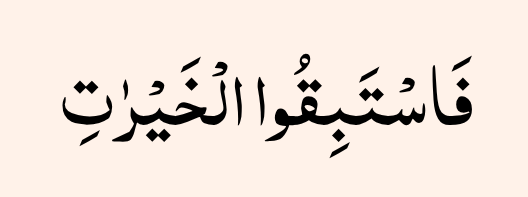
“…vie with one another in good works.”
The world encourages competition constantly: who has the better qualifications, the bigger house, the better clothes, the better holidays, the more successful children.
But Allah gives us something completely different to compete over:
Good works.
Imagine competing over who offers Salat most attentively; who serves others most quietly; who learns the Qur’an most sincerely; who obeys Huzoor most faithfully; who forgives first; who sacrifices more readily.
This is the competition worth winning.
At last year’s Ijtema, Huzoor-e-Anwar (may Allah be his Helper) reminded us that during the time of the Holy Prophet (peace and blessings be on him), many women had little formal education. Yet when the Holy Prophet (peace and blessings be on him) taught them about Allah and His commandments, they listened, they learned and they acted.
They became the shining stars of early Islam.
In this era, Allah has sent the Promised Messiah (peace be on him) so that his followers – men and women – may bring about that same spiritual revolution within themselves.
But as Huzoor has reminded us, revolutions are not born from convenience, comfort or words alone. They require sacrifice.
And sometimes the sacrifice required from us is actually very simple.
It is putting our phone away.
It is concentrating when somebody is speaking.
It is resisting the urge to have a conversation during an address.
It is giving our full attention to the words of Huzoor e Anwar.
We recently attended UK Jalsa for spiritual nourishment. Yet Huzoor-e-Anwar (may Allah be his Helper) specifically mentioned the issue of ladies talking during addresses. This is something we should take seriously.
What example are we giving our children?
If children grow up watching their elders talking while speeches are being delivered, checking messages or allowing themselves to become distracted, how will they learn to sit, listen and value the words being spoken?
Why have we come to Ijtema?
That brings us to today.
Why have we left our homes and families to come here? Why do we attend Jalsa, Tarbiyyati classes, meetings and Jama’at programmes?
The overriding purpose is education and spiritual rejuvenation.
Of course we should enjoy one another’s company. Meeting our sisters and renewing friendships is itself a blessing. But we should do so in a way that does not defeat the very purpose for which we came.
After making the effort to attend, we should ask:
Am I receiving what I came for?
If a speech is taking place, am I listening – or scrolling through WhatsApp messages?
If guidance from Huzoor e Anwar is being presented, am I reflecting on how it applies to me – or am I distractedly fixing my hair, checking my phone or talking to the person beside me?
When I hear something inspiring, do I simply think, that was a lovely speech?
Or do I ask:
What am I actually going to change?
Because the purpose of knowledge is transformation.
So, when we leave this Ijtema, perhaps each of us can take away three simple questions.
First: What is one temptation or weakness in my life that I need to restrain more carefully?
That is the first stage of taqwa: self-restraint.
Second: What blessing have I stopped noticing that I need to thank Allah for?
That is the second stage: gratitude.
Third: What good can I do for somebody else, purely for the sake of Allah?
That is the stage of the muhsin – doing good.
If we sincerely work upon these things, then, Insha’Allah, taqwa will not remain merely a word that we hear repeatedly in speeches.
It will gradually become the way we live.
We are immensely fortunate to receive the blessings of Khilafat. It is our responsibility to truly value and honour this institution by praying for our beloved Huzoor-e-Anwar (may Allah be his Helper), listening carefully to his guidance and, above all, putting that guidance into practice.
Let us remember the words with which we began:
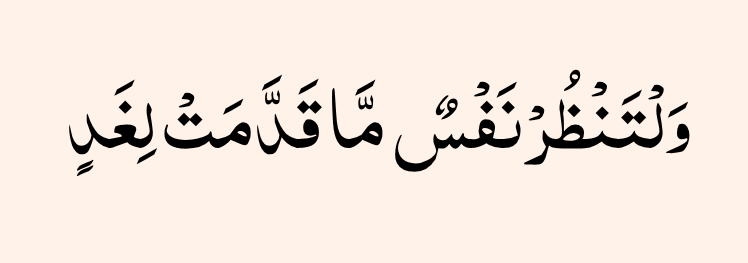
“…let every soul look to what it sends forth for the morrow…”
Every prayer we offer with sincerity, every temptation we resist, every act of gratitude, every sacrifice we make, every person we help, every word of Huzoor e Anwar we put into practice – these are what we are sending ahead for our tomorrow.
So, as members of Lajna Ima’illah, let us understand our responsibilities. We have been entrusted with the duty of conveying the beautiful message of Islam in this country and throughout the world and of playing our part in fulfilling the noble mission of the Promised Messiah (peace be on him).
May Allah enable us to become women and girls of true taqwa: women who restrain themselves for His sake, who recognise and cherish His countless blessings, who turn their difficulties into compassion for others, and whose knowledge is reflected in their actions.
May Allah enable us to value the blessing of Khilafat, to follow every guidance of our beloved Huzoor-e-Anwar (may Allah be his Helper), and to vie with one another – not in the material things of this world – but in good works.
May Allah enable Lajna Ima’illah UK to become an exemplary Lajna, worthy of the fortunate position in which Allah has placed us, and may He enable each one of us to bring about that spiritual revolution within ourselves which the Promised Messiah (peace be on him) came to establish.
Ameen.
JazakAllah


Leave a Reply