Iffat Mirza Rashid, Alton
Even someone who is as apathetic towards football as I am cannot ignore the hype and excitement of the football World Cup that comes around every few years. It infiltrates every aspect of English life, from shop window décor, to the adverts we see, to the family and friend meetups which inevitably turn into group watches.
This year, however, I felt as though the World Cup had been tainted just ever so slightly. Where I’d usually be very open in my support for England and enjoy seeing the England flags in people’s windows, or hanging off their balconies etc, the reappropriation of the flag from late 2025 has meant that the notion of Englishness (and by extension Britishness) has been highlighted as far more controversial than it needed to be. Whereas it used to feel as though Englishness was constituted by an attitude of inclusion, it now seems as though a certain group of the public wishes to define it by an attitude of exclusion – British values are being destabilised as a result. As a result, even if I want England to win, I feel as though that loyalty is subject to greater scrutiny than it needs to be.
However, it is not the football which brings out my loyalty to England every summer, but rather I feel a profound sense of belonging and understanding of what are considered to be ‘British Values’ at the Jalsa Salana UK. How can this three-day event, organised by a Muslim Community, attended by tens of thousands of Muslims and some non-Muslims, many of whom are immigrants or children of immigrants, be such a symbol of British Values?
As the flag of the Ahmadiyya Community is raised on the first day of the three day event, so is the Union Jack, both standing tall and flying together – in flying together we see a beautiful display of loyalty and common values. Indeed, these common values are based on justice, tolerance, respect, and loyalty to one’s nation. In an address in 2012, His Holiness Mirza Masroor Ahmad (may Allah be his Helper) stated: “loyalty to one’s nation requires a person to display patience, to show morality and to follow the laws of the land”. Indeed, if all citizens of a nation, displayed these morals there would be much greater harmony in society. It would be a nation where Britishness is not constituted by the colour of our skin, or our birthplace, but by our shared values, the ones which work together to seek the prosperity of our country and society.
The cultural theorist, Stuart Hall, famously wrote:
“I am the sugar at the bottom of the English cup of tea. I am the sweet tooth, the sugar plantations that rotted generations of English children’s teeth. There are thousands of others beside me that are, you know, the cup of tea itself. Because they don’t grow it in Lancashire, you know. Not a single tea plantation exists within the United Kingdom. This is the symbolization of English identity – mean, what does anybody in the world know about an English person except that they can’t get through the day without a cup of tea?”
This rather poetic and humorous quote reminds us that Englishness (and as I mention, by extension Britishness) is very much constituted by globality. Even the most ‘English’ symbols is actually a reminder of England’s place in the world, and the world’s place in England. Just as all the components of tea are not individually ‘English’, their coming together creates the most quintessentially English symbol. Similarly, all the attendees of Jalsa may have come from far and wide, but together their demonstration of justice, tolerance, respect, and loyalty to one’s nation, express exactly the values honoured in British culture.
The helping hand, the kind smiles, the unity, all that we see at Jalsa Salana, the highlight of my year, illustrates exactly what this country’s values are built upon – the cup of tea that we all constitute.
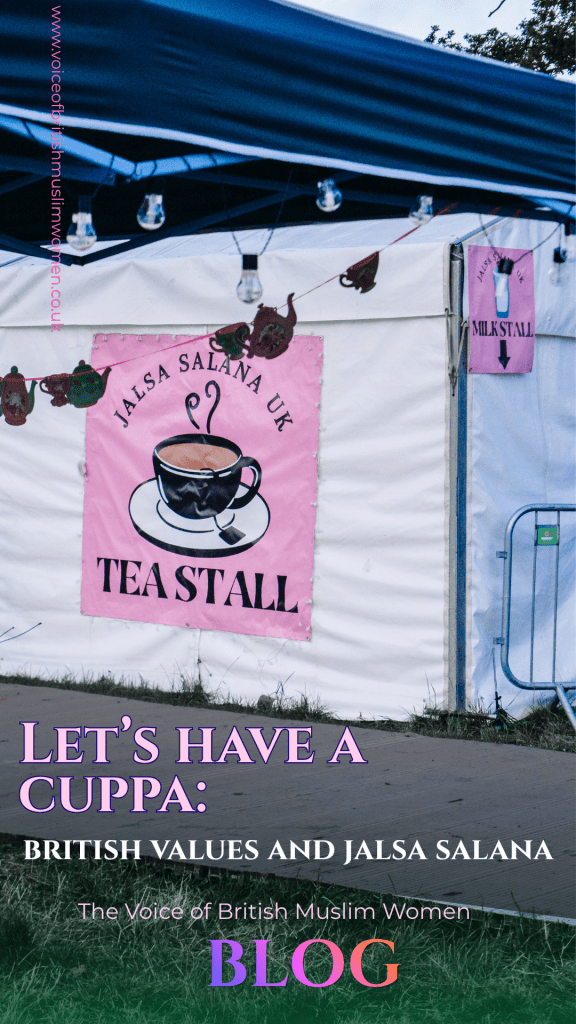
And if anything proves the ‘Britishness’ of Jalsa Salana, it’s probably the fact that the longest queue you’ll see there is for none other than the tea stall!


Leave a Reply