Journey Through Sound
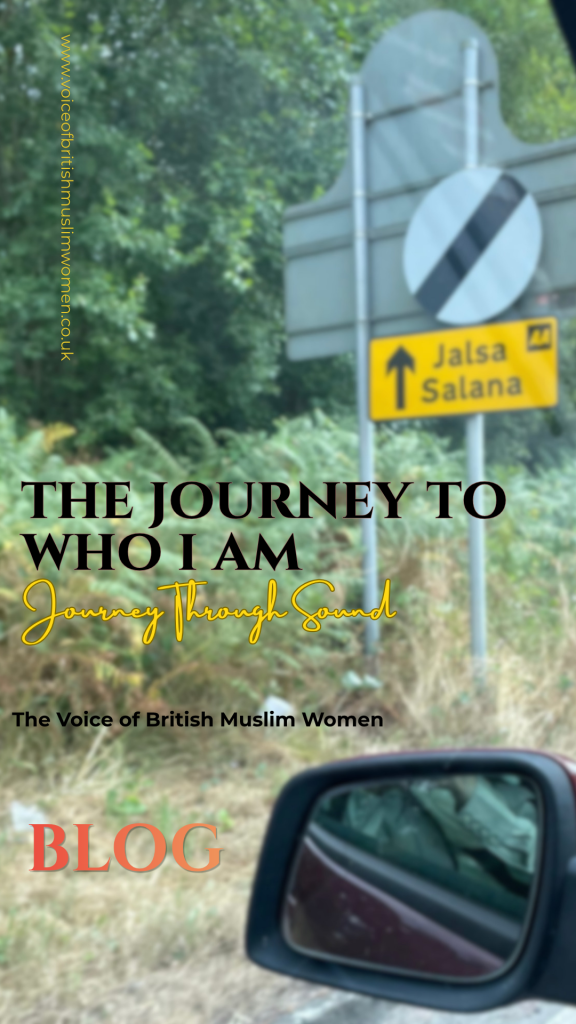
Hala Hadi, Deer Park
Childhood has a way of amplifying sound. At eight years old, I would sit in the back of my dad’s car, giggling as a mischievous gust of air slipped past the window and rushed against my ears, while we sped along the motorway. The deep grinding of the car engine would settle into the soundscape, mingling with the voice of my parents discussing if they would make it in time for International Bai’at* at Jalsa. An air of thrill had saturated the hour, as it does for all anticipatory things in youth. Sound felt like glittery accents across time, like the vivid moments of a dream. My dad would switch on the radio, to which Imam Sahib’s distinctly comforting voice would gently guide us to the protocol of International Bai’at. A sharp yell would occasionally introduce itself to the car, as I had accidentally pricked myself with a safety pin trying to put on my beloved ‘water duty’ badge.
Listening to the Bai’at preparation, I would repeat Imam Sahib’s words along with everyone else. It felt as though the world itself had learned to speak in unison beside me. I was especially captivated by the chorus of voices that emerged at the end of each line, as men speaking in different languages united in the same pledge. There is a particular warming beauty that lies in the united sound of overlapping pledges. Knowing that such a staunch declaration can come from so many far away homes. Like stars from different constellations, that all come together, in awe of one moon. That drowning noise of every language was the very essence of Jalsa for me. So many different people, with such unique ways of communicating, from such diverse places. All here, to overlap and drown in the noise of one cause, Allah.
Today, sound itself feels a little different. It has been softened by the tender hum of spiritual thought. Motorways have become a sonic vessel that carry the melodies of introspection. On the journey to Jalsa, the windows are still open, yet the sound of crisp air often goes unnoticed as my thoughts drift towards my relationship with Allah. Beneath the car, the engine still beats out its steady rhythm, but in my mind, it is soon replaced by the rustle of Istighfar (seeking forgiveness of Allah) and dhikr (remembrance of Allah). The sharp yelps that once followed an encounter with a safety pin have been replaced by bursts of gratitude. The skittish excitement for Jalsa remains, just as it always has, though it now sits beneath the weight of sacred reflection.
This is encapsulated perfectly in the Holy Qur’an 24:43, whereby all journeys physical or metaphorical nonetheless, end with Allah as the final destination:
وَاِلَی اللّٰہِ الۡمَصِیۡرُ
‘…and to Allah shall be the return.’
The miles of the journey seem to stretch not across land anymore, but across my psyche, carrying me through every emotion imaginable. It starts with anticipation of a small set of trivial worries, are my clothes properly ironed? Did I remember my AIMS card? It compounds into a moment of joyful frenzy; the thought of meeting friends and family. It then slowly softens, dissolving once more into spiritual fulfilment.
Every so often, my husband switches on a nazm* (devotional poem). Its melting tune punctuates the car, satisfying the craving of a gentle sweetness. Yet even this inspires a quieter reflection on whether devotion to my faith is as profound as the devotion the nazm expresses toward its subject. The sounds around me have not grown duller with age. Rather, they now compete with a soulful yearning that has become louder.
I will turn on the radio to Imam Sahib’s International Bai’at preparation. All the men will recite their pledge in different languages at the end of each line. Although many sounds have changed since I was eight, that sound will always feel the same.
*International Bai’at is a ceremony of the pledge of allegiance Ahmadi Muslims take at that hand of our Khalifa, His Holiness Mirza Masroor Ahmad at the Jalsa Salana. The international aspect being Ahmadis around the world join in via live television transmission.
*Nazm is an Urdu word for poem. Here the reference is to a poem of religious and devotional nature.


Leave a Reply