Bareera Ghaffar, Nottingham
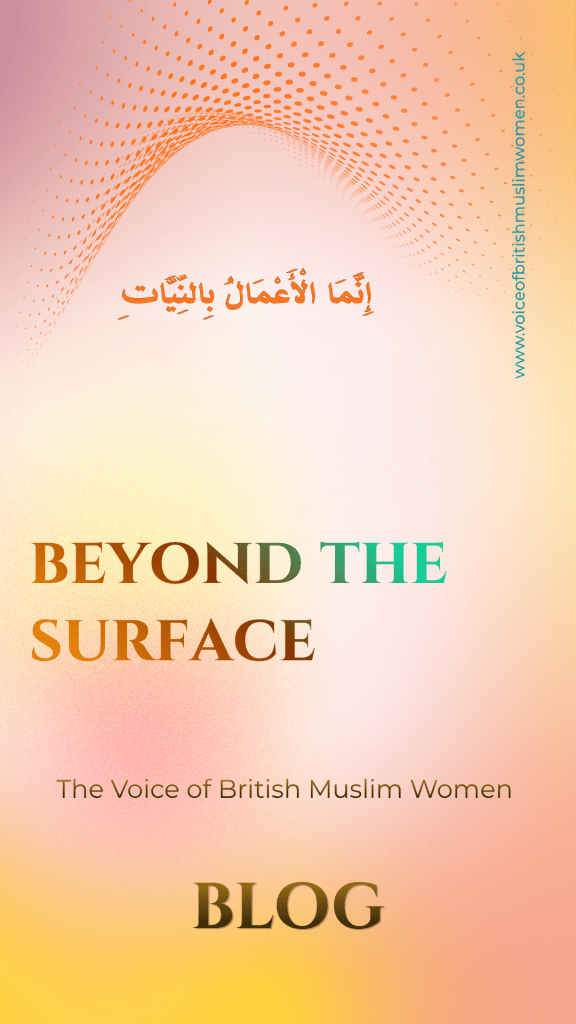
Nobody sees the inner mechanisms of our minds, only the action. Thus, no one has a full picture of why we do what we do and the motivations behind them – apart from Allah the Almighty. Intention (Niyyah) is a fascinating thing to decipher and Islam places great precedence on this fact; the intent of an action can completely change its meaning. Intention speaks to one’s values and the outcomes they wish for themselves and others. A portion of hadith Muslim children learn at an early age is, Innamal a’malu binniyat – Deeds will be judged by their intentions; it further continues wa innama likulli imri’in ma nawa… which translates to and that every person receives the reward for what they intended. This highlights the sheer weight by which intention and motivation is held within Islam. It begins the journey of introspection and analysing one’s thoughts, actions, and behaviours.
This concept shifts from being an external manifestation to a revelation of what lies within one’s heart. If two people carried out the same action, one out of empathy and kindness and the other to be witnessed by others, though the external effect is the same, the internal motivation could not be more dissimilar. Allah Almighty not only looks at the external action and rewards it but also the intention that inspires it. Therefore, intentions, and the thought of even doing good, is highly praised in Islam.
Within the framework of Islamic psychology, there is a profound emphasis on the interplay between one’s behaviour and intellect, the nafs (self or soul) and the qalb (heart). 1 It begs the question who do we do something for, and why? In Surah Al-Ikhlas verse 2-3 Allah says “Say, ‘He is Allah, the One; ‘Allah, the Independent and Besought of all”. The answer is evident, we do it for Allah, at full surrender of our own souls. Surah Al’An’am verse 163 states “Say, ‘My Prayer and my sacrifice and my life and my death are all for Allah, the Lord of the worlds”. Therefore, our nafs and qalb at full surrender to Allah the Almighty affects our intentions, a heart truly and unequivocally turned towards Allah will have He alone in its intentions. The Promised Messiah (peace be on him) writes regarding this submission to Allah that “With his Grace, I fear no trial – even if there are not one but a million trials. In the arena of trials and in the wilderness of suffering, I have been granted strength”.
The fundamental idea is that the goodness of our intentions, our inner monologues, and the stories we tell ourselves are crucial to our actions, behaviours, and therefore the state of our hearts. Modern psychology explains through neuroplasticity that repeated actions, thoughts, and exposure to stimuli can alter neural pathways, it can create new ones and if certain areas are not used, they can go through a loss of neurons and connections2. With how our body and mind are connected it is imperative that we keep the environment of our minds a clean, good place to be, a place full of kindness, compassion for oneself and others.
The rise of social media platforms comes with the rise of external validation and need to be seen ‘doing’ something. The blurring between what should be shared and what is personal, questions authenticity and performance, with self-awareness now lacking. Additionally, artificial intelligence does not have the intent a human has, and only knows how to follow a command, aiming to please you with an output without discerning your need to please Allah Almighty.
All actions, if done with the intention of goodness and keeping Allah in mind, are an act of worship. In every Prayer we set an intention “I have turned my full attention towards Him Who created the heavens and the earth being ever inclined to Him, I am not one of those who associate partners with Allah”. More than ever, we must ponder on who is being worshipped and who are the worshippers.
References:
1. Rothman, A., & Coyle, A. (2018). Toward a framework for Islamic psychology and psychotherapy: An Islamic model of the soul. Journal of religion and health, 57(5), 1731-1744.
2. Gazerani, P. (2025). The neuroplastic brain: current breakthroughs and emerging frontiers. Brain research, 1858, 149643


Leave a Reply