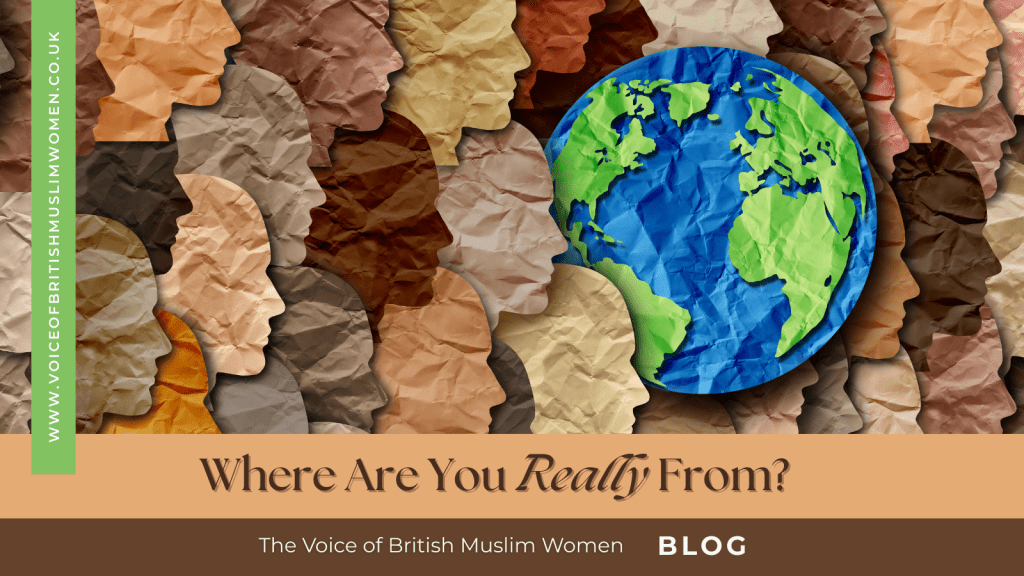
Danila Jonnud, Hampshire
If, like me, you’re ethnically non-white, chances are this is a familiar question.
On hearing it in primary school, I’d respond defiantly “I’m from HERE”, which didn’t convince those asking as they’d repeat it emphasising the “really” part. That would confuse me; I’ve answered, what else do you want to know? Of course, deep down I think I knew (hence ‘defiantly’) but it took a few more years of cognitive maturing before that realisation moved from the subconscious to the conscious.
When I acknowledged why they emphasised “really” I did the sensible and grown-up thing of being cheeky about it; I would tell them I was from our town, the hospital, from my mother, or tiny little cells. Basically, I annoyed them into giving up and not asking again.
I made a joke out of it, but the sentiment remained that I was either evading the question or that I just didn’t understand the incredibly subtle emphasis of “really”. Yet, my first response was the most truthful; I am from HERE, which is to say England. Those kids, froma very un-diverse community, were in fact asking, “why don’t you look like us?” or “where does your brown come from?”. And it’s interesting, because even though kids aren’t always tactful, they still knew not to ask as bluntly as that.
I loathed that question, because no child wants to be perceived as different from their peers, especially being a minority in the classroom. But now, it doesn’t bother me as I remember that it was children asking, and it’s not their fault they don’t know the complex difference between ethnicity and nationality.
Moving into young adulthood, it got tiresome. To be seen as a foreigner in my own country is my most motivating factor to break out every conventional British slang known to mankind, express loudly how a cuppa would be nice, despite not drinking tea, and bemoan the weather with all the British sensibility in my soul. I’m joking obviously, but I felt I had to prove where I was from and who I am, to avoid the emphasised “really” which turned me into an outsider.
After moving to attend a diverse university in the city, I was glad I had put behind me the days of childish questions and could look forward to a community much more knowledgeable about that vital difference between ethnicity and nationality. As it turns out, everyone was too knowledgeable, and instead of children who don’t know better, that question came from students who had likely heard it themselves. People who were ethnically non-white and nationally British asked me “where are you from?” and in response to my wary “here…” came “but where are you really from?” followed by questions about my parents and grandparents. The subtext remained the same; “where does your brown come from?” but because they wanted to know why I do look like them, instead of why I don’t.
This trip down memory lane is really to show one thing; being British was never enough. Someone on a bus, or in a lecture hall looked at my skin and my scarf and tried using those factors to determine where I am “from” (and all been wrong) as if I’m an equation and everyone wants to know what I equal.
The password to belonging was to answer satisfactorily, the question “where are you really from?” and prove that you deserve to be part of either the majority or the minority.
The good thing about facing this question now I’m older, is that I can see just how complex it is without being worried by it. It once bothered me that I couldn’t answer it in a way that made everyone happy. Every answer I can give is simplistic, reducing me to being “from” somewhere than being someone. It matters, yes, it creates communities and relatability, and a sense of connection even with complete strangers, but I can still have that without definitively being “from” one place, one culture, and one idea of living. And as I experience more of the world, I realise how interesting it is to have more than one part of the world as part of me.
My grandfather was “from” Kashghar in China; his ancestors were “from” somewhere around Türkiye. My father was born and raised in Pakistan and moved to England as an adult. My maternal grandparents were both born in India, moved to Pakistan post-Partition, yet have spent most of their lives living and working in England. My mother was born in England. So, you tell me, where am I really from?
You see it’s not about what the equation equals, it’s about being the equation, embracing all the parts, enjoying the complexity of being the product rather than breaking it down to know where it was manufactured. It’s fun to see my paternal uncles have a tradition of wearing red fezzes to events and to be told by the elders about the benefits of drinking hot water. I like going to weddings or Eid at the mosque in clothes from Pakistan and greeting the aunties who aren’t related but still watched me grow up. It’s interesting to study Mandarin and find it easier to translate familial terms like Jiějiě to Baji (older sister) and find the similarities and differences between the cultures I grew up with and the ones I learn about. And it’s pretty cool to sit in class learning about the Muslim communities of China, and wonder if my grandfather knew those streets, those foods, or those words.
I’m proud of my heritage. I love most of the cultural influences of my upbringing, and I enjoy the idea that I can belong to many different groups. I want to learn languages and embrace fashions and ideals from all sides of my identity. The point I’m trying, via the scenic route, to reach, is why is it better to be one over another? Why does answering, “here” invite doubt, suspicion, a follow-up? Why can it not just be the truth?
I guide my life according to Islamic principles, not a question of nationality. And I don’t think that conflicts with being British, Asian, Turkish or anywhere else that people are “from”. Islam tells me the most fulfilling way to live my life, and I choose to incorporate the best parts of everywhere else that I am “from”, including belief in democracy, rule of law, liberty, respect, and tolerance which I learnt my whole life are British values.
So, yes, if you’re curious you can ask. But don’t be surprised, doubtful, or suspicious that, with values like those, I don’t want to change my answer from saying defiantly, warily but also proudly that I am from HERE.


Leave a Reply