Tooba Khokhar, Cambridge
“Look, therefore, at the marks of Allah’s mercy: how He quickens the earth after its death.”—The Holy Qur’an, chapter 30, verse 51
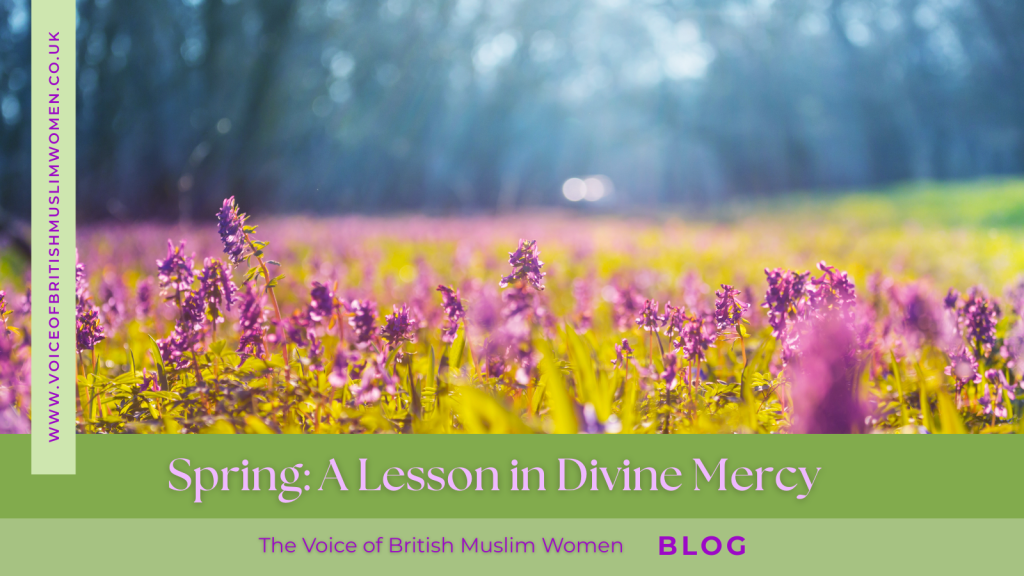
Spring has once more come to fill with beauty and freshness the landscape of the British isles. The “darling buds of May” bloom as they do every turning of the earth. No matter how despondent the winter that has passed before it, the soil ripens around us yet again.
The Holy Qur’an invites us to reflect on the workings of the natural world. “In the creation of the heavens and the earth and in the alternation of the night and the day there are indeed Signs for men of understanding”1. It is without a doubt that the patterns and rhythms of nature have much to instruct us. As the Bard of the Lakes playfully remarks:
Books! ’tis a dull and endless strife:
Come, hear the woodland linnet,
How sweet his music! on my life,
There’s more of wisdom in it.And hark! how blithe the throstle sings!
He, too, is no mean preacher:
Come forth into the light of things,
Let Nature be your teacher.2
In the Holy Qur’an, we are told that Allah causes “qabd” (contraction) and “bast” (expansion)3. Certainly, the human heart goes through many cycles of qabd and bast, of contraction and expansion, of sorrow and ease in the seasons of life. But it is enough to cure our despondency that even the most shrivelled branches in December will be fruitful and rich in May.
Spring is a message from the Divine of His Mercy that never ceases. It is a sign that the earth and all on it are in motion not in stillness. It is proof that the water of Divine Beneficence follows after periods of drought. And it is an invitation to look upon the world as it renews itself, and to turn to our own selves to do the same.
Our outer forms may not have the timelessness of blossoms and buds, and each Spring we meet their familiar contours in an altered state. But our hearts and souls, if guarded over well, can with each passing year grow more receptive to the marvels around them.
As Larkin muses on the sight of trees in Spring
Is it that they are born again
And we grow old? No, they die too,
Their yearly trick of looking new
Is written down in rings of grain.Yet still the unresting castles thresh
In fullgrown thickness every May.
Last year is dead, they seem to say,
Begin afresh, afresh, afresh4
1- The Holy Qur’an, chapter 3, verse 191
2- Wordsworth, ‘The Tables Turned’
3- The Holy Qur’an, chapter 2, verse 246
4- Larkin, ‘The Trees’

 Voice of British Muslim Women
Leave a reply to Yusra Cancel reply