By Saadiyya Khan, London
When I first heard of the opportunity to go on a survival weekend organised by Lajna Health and Fitness department, I immediately thought ‘not for me’; I’m a city girl who lives for home comforts and Netflix. And friends and family said ‘You can’t rough it! Why’d you sign up?’ Two reasons: what appear to be impending challenges of Brexit and the words of our beloved Khalifa, Hazrat Mirza Masroor Ahmad.
His Holiness said at the Calgary Peace Symposium on 11 November 2016,
“Storm clouds forewarning us of a Third World War are getting heavier by the day. The effects of such a war would last for decades to come.”
So this was my way of preparing for both scenarios; trying to ensure that if life got less than comfortable, for whatever reason, I’d be realistic and equipped with the right skillset. To say that I was a little apprehensive about spending a night in the woods, in the open air, is an understatement. Whilst the thought of creepy crawly critters getting too close for comfort while I tried to sleep in the frigid night air was daunting, I knew the experience, and what I’d learn from it, would be worth the challenges.
And so it was.
After a surprisingly exhausting 6km hike (which included being chased by cows and temporarily going awry in a Stephen-King-esque field of corn), we arrived at our large campsite with a cozy fire. The rest of the afternoon consisted of learning about the various types of vegetation around us, what it could potentially be used for and which of it could be safely eaten. It never ceases to amaze how much Allah has provided for us and how much of it we take for granted. He is truly Ar-Razzaq, The Provider.
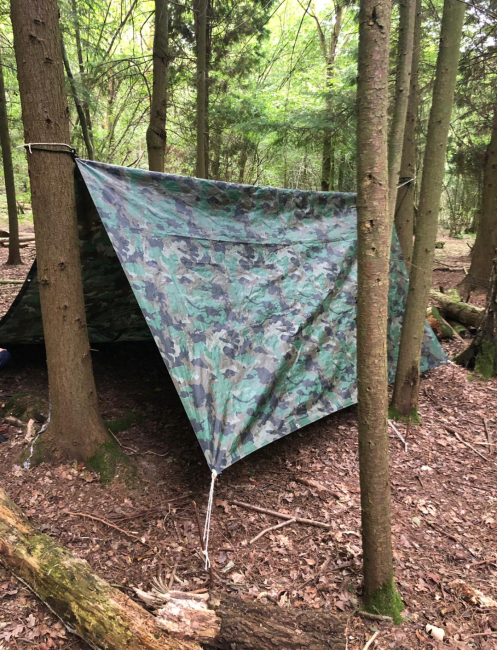
Before sunset we set up camp which included attaching large plastic tarps to trees and gathering foliage for bedding. The night was as predicted: creepy crawly critters, freezing air, punctuated by alternating laughter and screams of scared school girls throughout. All of which, to my amazement, I managed to ignore and obtain a few hours’ sleep.
The first session of the second day taught the ultimate survival training skill – how to obtain drinking water in the wild, in an emergency. I have never been more grateful for the blessing of tap water that is safe to drink. The process of purifying and then sanitising the water from the nearby pond was laborious and lengthy. We learned that only 2.5% of our planet’s water is freshwater and only 1% of this is easily accessible, (1)
The next challenge was learning how to start a fire in an emergency using materials you might have to hand. Like the water purification, this process was far from easy and I found myself being grateful again, this time for the spark in my boiler. Whilst necessary to human survival, heat and fire are not to be trifled with. They must be contained and safely extinguished. As the ever prevalent news of forest fires and the burning of the Amazon rainforest (aka the world’s lungs) has shown, we must safeguard the trees and vegetation which purify our air.
The last session was the one I was most looking forward to – knife-handling. The knives provided were very sharp and learning how to use them safely (to chop wood, prepare materials to build a shelter and skin wood for use in food preparation) was crucial. The most repeated phrase from the instructor was to stay out of the blood zone – the radius of reach around a person handling a knife.
Over the weekend nearly all us cooked over the open camp fire, cleaned, washed up and prepared food. Whilst most of the tools required for such activities were provided, there were times we had to improvise, providing opportunities for learning and creative thinking.
One of the most significant benefits of the weekend for all participants was disconnecting and reconnecting. It was a relief to be free from my mobile, which had become an extension of my hand; forever attached and visible. It was a detox I very much needed. And looking up from my mobile-less hand I found forty-six Lajna, sisters in faith, of all ages and backgrounds, laughing, exchanging experiences and advice, examining their lives for how changes in their daily habits could reverse the impacts of the climate crisis; not just surviving but thriving; perfectly conceptualising why such events are so valuable and necessary.
1 https://www.nationalgeographic.com/environment/freshwater/freshwater-crisis/

 Voice of British Muslim Women
Leave a reply to Roop Faheem Cancel reply