War
-
Iffat Mirza Rashid, Alton It’s shocking, really, the amount of resources, money, and attention humans put into developing tools to kill fellow humans. I think what enables this drive for destruction comes partly from the fact that we cannot, or rather do not, humanise each and every victim of war. In fact, we do not…
-
Sameea Jonnud, Hampshire It’s October 2024 and I sit down one morning with a cup of coffee; the Al-Jazeera news channel is on the television and I leave it running. The segment happens to be about the US election but I don’t hear what is being said as my eyes follow the ticker tape at…
-
Ayesha Naseem Mirza, Walsall It is commonly believed that time flies. A week starts and ends in the blink of an eye. Before you know it, it’s Friday again. It feels as if hours are passing in minutes and minutes in seconds. But a life like this is a privilege. Where this realisation is humbling…
-
Saira Bhatti, Slough All it takes, all it should take, is one person To set the wheels of truth into motion. The truth. Let’s talk about the truth. Is the truth free or is it constantly under siege? How do we hold onto peace amidst raging conflict? Journalism – this noble profession – shines a…
-
Sarah Ward The shot that was heard around the world. I can envision it even now. I learned about it in school annually. One of those pivotal aspects of growing up ‘British’. A young man enjoying his life when he was cruelly assassinated – his life snatched brutally away- we were told. This act propelled…
-
Under the banner of Voices For Peace, Podcast 15 features Iffat Mirza and Danila Jonnud discussing the importance of advocating for peace in our unsettled world.
-
Sameea Jonnud, Aldershot Throughout time and around the world, women have always suffered more than men. It has generally been men in power, men instigating and fighting wars, men making laws while women were at a disadvantage in status, education, marital rights and, more recently, in the workplace where they have had to combat unequal…
-
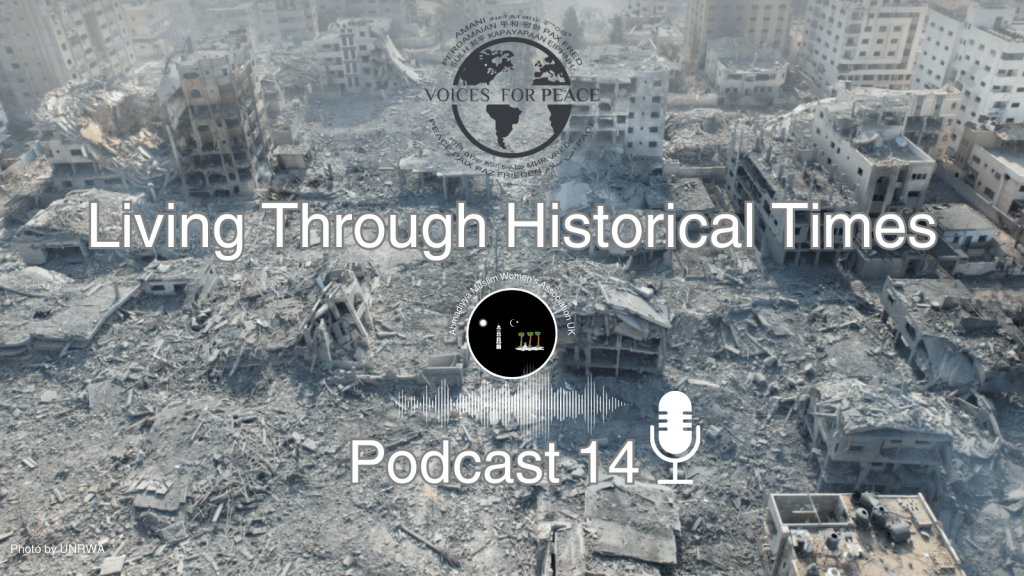
Our podcast 14 is the first podcast we have made against the backdrop of #voicesforpeace, a global campaign launched three months ago by the Ahmadiyya Muslim Community to bring an end to the war in Gaza and establish peace. Ayesha Naseem and Dur-e-Shewar Anwar discuss living through the historical times of the conflict while being…
-
Nooresahar Ahmad, Hampshire In Ghassan Kanafani’s short story ‘Letter from Gaza’, written in 1956, the unnamed narrator writes a letter to his childhood friend Mustafa, who has left Gaza and is living in Sacramento. The narrator and Mustafa have had a joint plan since they were young, to leave ‘this Gaza’ and ‘the ugly debris…
 Voice of British Muslim Women