Nooresahar Ahmad, Hampshire
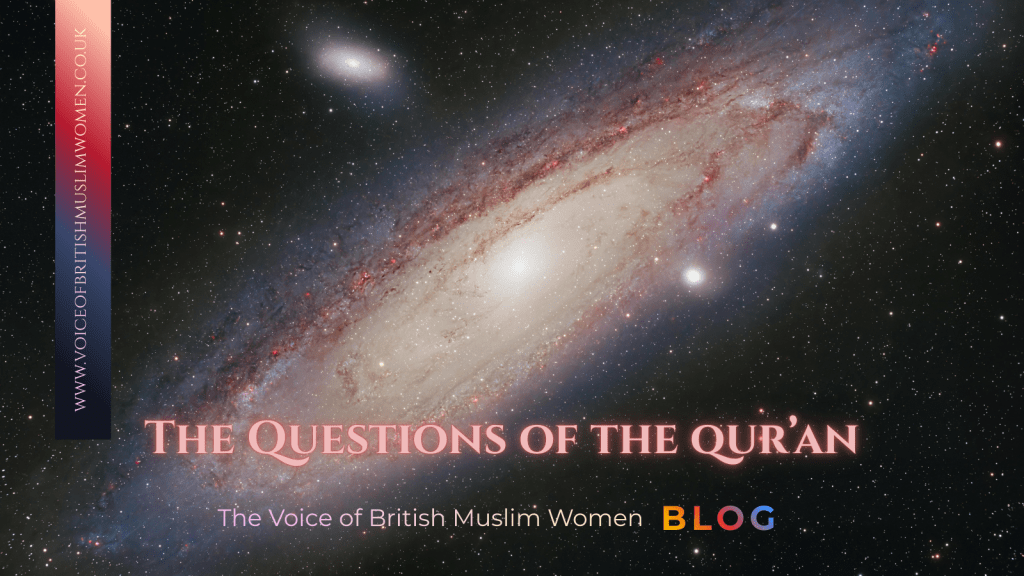
In a recent reading of the Qur’an, I stopped at a particular verse, the translation of which read: ‘What is the matter with you that you do not ascribe dignity to Allah?’ (71:14) I sat with the question for a moment, before continuing to read. Another verse later, however, and I was back at another query: ‘Have you not observed how Allah has created seven heavens in tier upon tier?, And has placed the moon therein as a light, and made the sun as a lamp?’ (71:16-17).
This is not the first time I have been stopped in my tracks by a captivating question whilst reading the Qur’an. Other examples I have highlighted in my copy of the Book: ‘…This is Allah, your Lord. His is the Kingdom. There is no God but He. Whither then are you being turned away?’ (39:7); ‘And worldly life is nothing but a sport and a pastime. And surely the abode of the Hereafter is better for those who are righteous. Will you not then understand?’ (6:33); ‘…And who is more faithful to His promise than Allah?…’ (9:111).
The best teachers understand the importance of asking one’s students to question things. Harvard Medical School teachers point out that ‘the practice of asking questions is an effective way to promote the type of critical and creative thinking needed to solve complex problems.’ Any good teacher aims to help their student become a better learner, with a mind that is curious and open to new ideas, and well-equipped to encounter any future problems. And in the Qur’an, the reader is treated as a kind of student, constantly being prompted to expand their mind. As scholar Daniel A. Madigan notes, the verbs used in the Book are ‘strikingly intellectual — learn, reflect, reason, remember, heed, perceive, think’. Questions are also used to prompt intellectual consideration from the reader. They appear in recognisable refrains: ‘What is the matter with you?’ ‘Will you not then see?’ ‘Why do you not…?’ These questions act as a kind of prodding to the reader, encouraging them to look at the things they know well — the moon, the sun, the stars, the mountains, the animals, the earth — and to consider them properly, deeply, anew.
This is a unique aspect of the Qur’an; that it constantly encourages its readers to think deeply, to ponder and reflect. It draws attention not just to objects and beings, but also to concepts, such as the origins of life. Once such a concept has been introduced, the questioning begins: so, the Qur’an asks, ‘Have they been created out of nothing, or are they themselves creators?’ (52:36) The route then taken by the person considering this question is up to them, but one thing is clear: blind acceptance of things as they are is no way forward. This life and the world around us is a complex, finely balanced thing that we must not experience thoughtlessly; things must be called into question, and it is only through attempting to answer these questions that a deeper clarity can be achieved.
Many scholars have thus been encouraged by Qur’anic verses to investigate the cosmos and the natural world around them, which has led to groundbreaking discoveries in mathematics, philosophy and astronomy. This was true during the Islamic Golden Age, but still occurs even in more recent years; the Nobel-laureate physicist Abdus Salam, for example, has spoken often about how his faith encouraged him in his scientific endeavours.
But it is not just scientific enquiry that the questions of the Qur’an urge a reader towards. Ultimately, they direct us towards our ultimate purpose: spiritual development. Slowly, we unwind a string of questions — how did the moon, stars and all natural elements come to be so finely balanced? Who has power over us? What are our hearts drawn towards? — until we come to our final answer.
 Voice of British Muslim Women
Leave a comment