Iffat Mirza Rashid, Alton
The word ‘friend’ comes from the Old English frēond, meaning ‘loving one’, ‘friend’ or ‘relative’. This word ultimately derives from the Proto-Indo-European root prī-y-H (‘to love, to like’), which is also the root of the word ‘free’. Therefore, it can be said that the core meaning of ‘friend’ has always not only been tied to the concept of love and affection, but also has relations to the idea of ‘freedom’.
The concept of freedom can vary depending on time, place, and the magnanimity of the situation. But nobody can deny, after seeing two years of violent atrocities being committed against the people of Gaza, livestreamed onto our devices, that there is an immediate need for freedom for the Palestinian people against the tyranny of unjust oppressors. And to hearken back to the etymological roots of the word ‘freedom’, we must be a ‘friend’ to the people of Palestine.
It sounds simple, a bit cliché and cheesy even – but what is solidarity if not an expression of love and friendship that transcends borders, races, ethnicities, and creeds. One key example in recent memory of this notion actually comes from within Palestine. After the murder of George Floyd in 2020, which sparked global outrage and protests for racial equality, a Palestinian artist painted a mural of Floyd in the West Bank. This expression of friendship showed that there is support from all corners of the world, even when in those places huge injustices are being carried out.
Of course, the feeling of helplessness weighs heavily. Scrolling from one video to another… to another…to another…to another… all laying bare the consequences of the kind of unchecked brutalities that have become so normalised in the last two years, means that we can feel worlds away from a ruthless reality. But the reality is that the brutalities we see are larger than any one of us. They are not, however, larger than all of us.
Unity, particularly in times like this, cannot be understated. To stand in solidarity, whether in our hearts, with our tongues, or by our actions, is a powerful statement to an oppressor. The oppressor yearns for the day when his victim is silent and unseen. That is the day the oppressor wins. Until then, no matter how large their machinery, the advancement of their weapons, or the billions funding their aggression, the oppressed stand a chance. And to ensure this remains the way, those of us who are not direct victims must speak and stand with the oppressed.
At the international conference of the global charity, Humanity First, His Holiness Mirza Masroor Ahmad (May Allah be his Helper) beautifully instructed that we must ‘be those who stand ever-ready to wipe away the tears of those who are in distress or hurting in any way’. The beauty of these words points not just to the fact that we must remove or work towards removing the cause of the tears and distress, though we must do so, but also that in the process of doing so, we can be a source of comfort to the people who need it most.
Today, thanks to social media, more of the world’s injustices are coming to light. Recently, a harrowing satellite image of Sudan’s city of El-Fasher, cloaked in blood, was published, and another video of a mine collapsing in Congo went viral. Seeing these images and videos, along with the atrocities in Gaza reminds us that freedom is fragile, and that in order to attain it, we must show solidarity to the oppressed peoples of the world. A genuine love and friendship for the people of the world must be fostered. To be able to meaningfully ‘wipe the tears’ of the distressed, we must fill our hearts with so much love, and we must feel their anguish as our anguish.
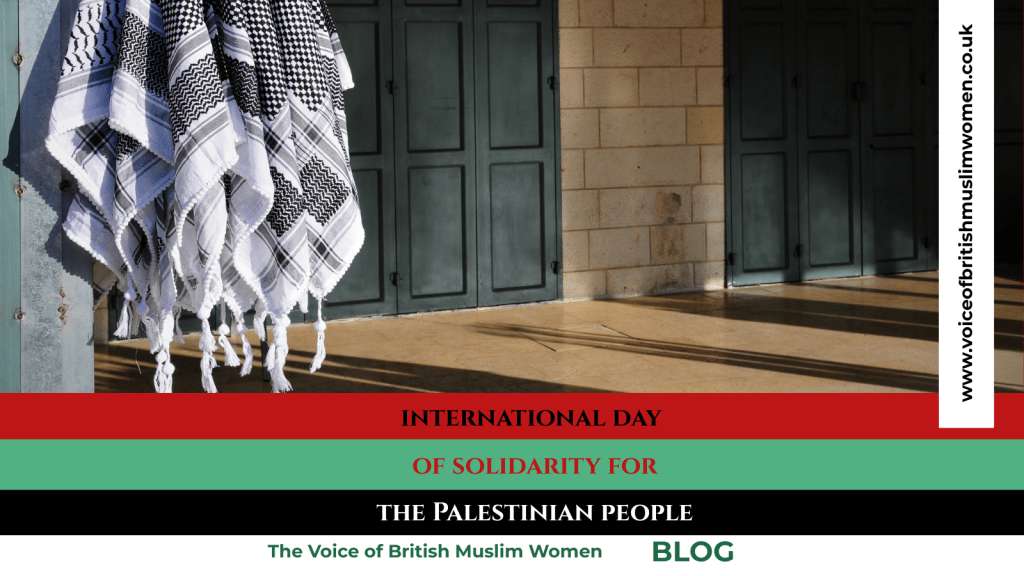
Today, 29th November, is International Day of Solidarity with the Palestinian People. Though today may be a day of particular commemoration, every day we can do our very little bit to show our expressions of solidarity. Whether that is through financial sacrifice and aid, through speaking on the topic, reading and learning more about it, humanity must prove itself. And by infusing this with a spirit of love and friendship, remembering that it is not that far from the idea of freedom itself, we can see a world without oppression: in Palestine, in Sudan, in Congo, and every corner of the Earth where oppressors believe themselves to reign supreme.
 Voice of British Muslim Women
Leave a comment