Danila Jonnud, Hampshire
While scrolling online the other day, I saw a post listing certain crimes which made the news in Britain, captioned “I’m tired of being tolerant”. The account was an ordinary person’s, with only a handful of views, and yet for some reason it stayed with me.
Tolerance can be a lot of things. Teachers use it to prove their strictness to students. Companies use it as part of policies on inclusivity and harassment. Britain uses it as a British value. It’s a word that conveys many different ideas.
Normally, I use it when I’m talking about how far I can handle something, like I can tolerate a lot of readings for Uni, but I cannot tolerate horror films. In recent months however, I’ve been thinking about it in the British sense, because of the flags, and the rallies, and the fear that the patience of those supposedly tolerating ‘us’ will suddenly run out.
By ‘us’ I mean the ‘other’, I mean the ‘them’ that those who put up flags, go to rallies, and post on social media, shout about stealing their jobs, homes and safety. Ironically, I was always both ‘us’ and ‘them’. Kids in school would say I wasn’t like ‘them’ even if I looked like it, yet I wasn’t ‘one of us’ either, well, because I looked like ‘them’.
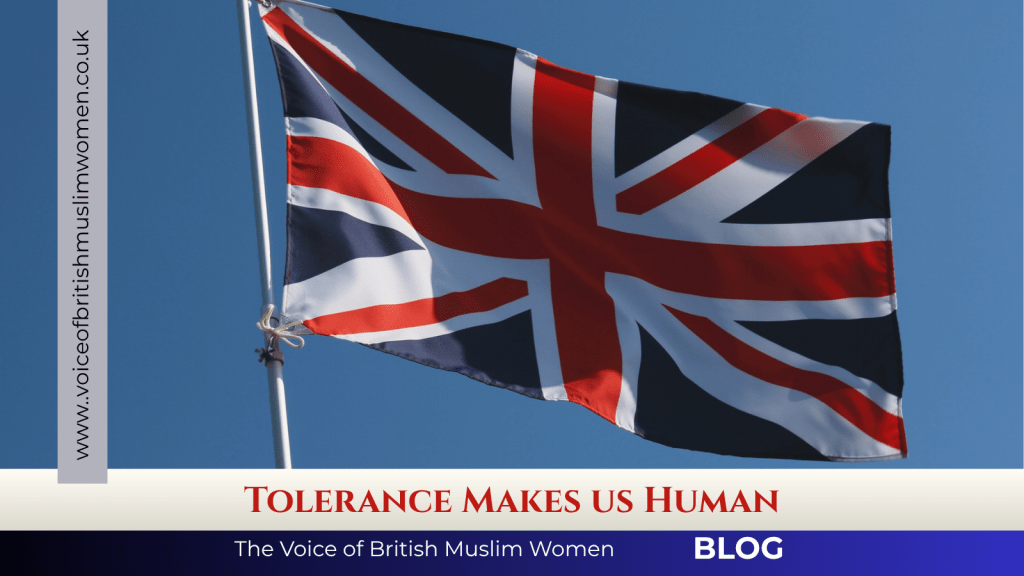
Let me explain this better. When I first saw the flags on lampposts along the street, I felt afraid then patriotic. Afraid wondering if it was motivated by division, and patriotic because the Union Jack is my flag reminding me especially of the 2012 Olympics when I was six years old, loving every second of being the host nation. The St. George’s Cross had a similar effect, recalling summertime and the faint melody “it’s coming home…” which we sang walking home from school. That’s why the ‘Raising the Colours’ movement is so cruel; my flag which brings good memories and patriotic feelings, has been turned against me. I was nervous walking the streets I was born and raised on because of those flags, and instead of being proud and happy to see homes flying it, I walked past quickly, determined not to be bothered by it, determined not to show I care, even though I was deeply troubled.
I was upset and I was angry. Am I not human? Do I not laugh and cry, do I not grieve and try, do I not work hard every day, and watch the same things as a million other people when I come home to relax? Am I less than? Must I prove over and over and over again who I am and why I deserve to exist, to have space, to breathe freely in a country that promised us the freedom to breathe? My family worked and gave to the economy; I persevered despite difficult circumstances to go to university where I am currently and will learn how to contribute to that same economy. Once, the subject of the Partition (of India in 1947) arose and I said “it’s awful what happened to us” and “it’s awful what we did”, and then I paused because even while talking about atrocities, I identified with both sides, ‘we’ the perpetrators and ‘us’ the victims.
And that’s because it’s not a maths equation. I don’t have to be either/or, right or wrong, one motherland, one mother tongue; being more than one state, way of life, and identity, does not make me less British. I can be both.
Today is International Day for Tolerance, but rather than speaking about international matters, I’ve ended up speaking about me. I’ve made it personal because, as the post I mentioned shows, it’s easy to stop tolerating a statistic and a group which is constantly ‘othered’ in everyday life. I made it about me so I can show that I am the same because I am human, and feel happy and sad and tired, but I’m different because I am human, and we’re all different, all unique, and all have free will. And if what I feel means I can be tolerated, so can the people like me, who have similar experiences, similar beliefs, similar skin tones, but are still individuals.
I always thought of tolerance as a measure, a word and idea with an ultimatum or a limit. I thought of it as something which ebbed and flowed, a precarious scale to be careful with so as not to tip it the wrong way, or a dam holding back the true thoughts someone was thinking. But learning about today made me think differently; the Declaration on Principles of Tolerance adopted by UNESCO 30 years ago1, describes tolerance as “neither indulgence nor indifference. It is respect and appreciation of the rich variety of our world’s cultures, our forms of expression and ways of being human.”
Not a limited measure, but a starting point. Not a dam but a gateway.
In other words, tolerance is (or should be) the basis of human co-existence, rather than the ultimate goal. A utopic dream for sure, and yet we would be nowhere without our yearning for better. Asking others to tolerate me was the bare minimum, but by the definition UNESCO gives us, it’s also an opening, an opportunity to learn and grow, to be broadened and change our minds about people even if we’re set in our ways and sure that we’re right.
And I think this is the version of tolerance which is the core British value. Rather than simply not hating each other, it’s about uniting our communities, appreciating that what makes us different, makes us human, and even if there’s nothing else, we’ll always have that in common.
So today, I’m not as angry or sad anymore. I don’t have to ask what it is I don’t do or feel which might prevent me from being accepted. Because I’ve realised, the real danger to British values and British culture – one which today reminds us to fight against – is forgetting or getting “tired” of being tolerant. And just like the flags flying along the streets, in the spirit of patriotism, I think we should all strive to be more British, because being more British means being more tolerant, and being more tolerant means welcoming those who are different with open minds and open hearts.
 Voice of British Muslim Women
Leave a comment