Unaizah Ahmad, Chester
In our world mired in conflict, dissension, and division, truth-telling and justice have taken the worst hit. When truth is attacked from all fronts, those who strive to uphold it become the prime targets.
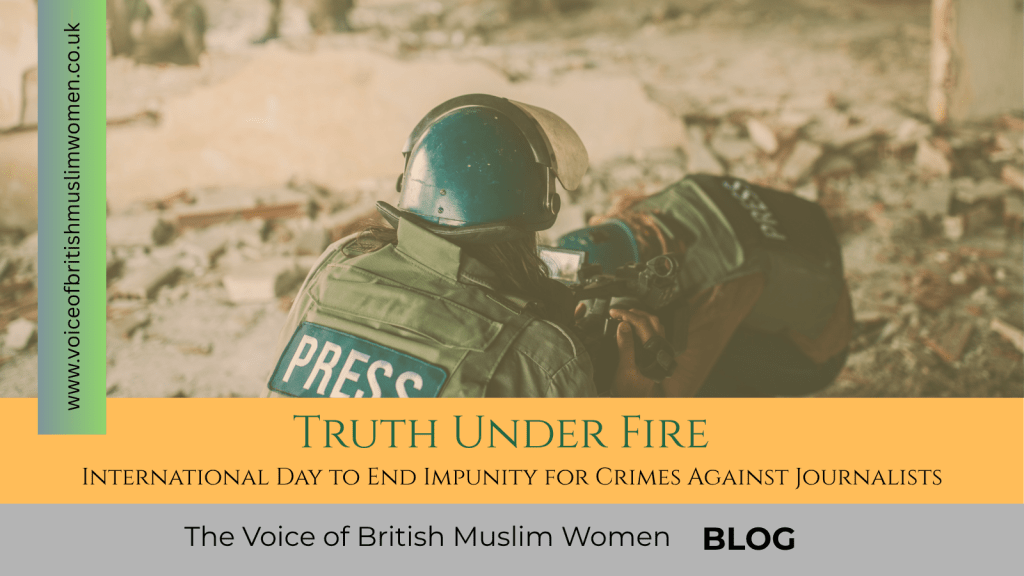
According to UNESCO1, between 2006 and 2025, over 1,800 journalists have been killed around the world. And as per a recent report2, at least 248 journalists have been killed in Gaza which is reported to be more than in any other conflict in modern times.
The threat to journalists speaks volumes about the power journalism holds. It can influence the course of politics, shape the trajectory of conflicts and give voice to the oppressed. It can be the lens through which the world witnesses the misery and suffering inflicted upon people serving as the desperately needed wake-up call for humanity.
When carried out with integrity, a journalist becomes a messenger of truth, and this noble role can be instrumental in the establishment of peace and justice. Integrity in journalism, as in any moral pursuit, requires truthfulness, a value deeply rooted in faith. The Holy Quran teaches a simple and straightforward principle to uphold integrity:
“And confound not truth with falsehood nor hide the truth, knowingly.” (2:43)
Hiding the truth is not only confined to false reporting and censorship but the attack on journalists itself is an attempt to hide the truth, knowingly. In suppressing truth, we pave the way for injustice.
2 November marks the International Day to End Impunity for Crimes Against Journalists. Crimes against journalism and impunity against crimes both point to deep-rooted injustice and inequality. It is no secret that when injustice is practiced at one level of society, it seeps into others until the entire world becomes engulfed by it.
At the cornerstone of Islamic teachings lies the protection of the rights of others and rejection of all forms of injustice. Islam teaches that just as we would not tolerate our own rights being violated, we must not be willing to let that happen to others. We cannot advocate for the rights of one group while undermining the rights of another, nor stand up against oppression in one part of the world while turning a blind eye elsewhere. This is selective justice, and selective justice is no justice at all.
Islam has laid out the highest possible standards of justice in the Holy Qur’an:
“O ye who believe! be strict in observing justice, being witnesses for the sake of Allah, even though it be against yourselves or against parents and kindred. Whether he be rich or poor, Allah is more regardful of them both than you are. Therefore follow not low desires so that you may be able to act equitably. And if you conceal the truth or evade it, then remember that Allah is well aware of what you do.” (4:136)
“O ye who believe! be steadfast in the cause of Allah, bearing witness in equity; and let not a people’s enmity incite you to act otherwise than with justice. Be always just, that is nearer to righteousness. And fear Allah. Surely, Allah is aware of what you do.” (5:9)
His Holiness Khalifatul Masih V, (may Allah be his Helper) the worldwide head of the Ahmadiyya Muslim Community, has been drawing the attention of world leaders and politicians to the need for upholding absolute justice at every level of society for decades. He has repeatedly emphasised that no party should be given preferential treatment, or favoured unduly, and has stated:
“…Islam teaches that in all circumstances, no matter how challenging, you must remain firmly attached to the principles of justice and integrity.”3
We often realise the true value of something only when we are faced with the risk of losing it. In the current age of rising misinformation and disinformation, it is becoming increasingly difficult to discern the truth. Hiding the truth may begin with words, fabricated images and videos but ends with endangering the lives of those upholding it.
To preserve a value so central to our existence, it is imperative that we each play our part in upholding it in our own lives. For peace is inseparable from justice, and justice from truthfulness.
References:
 Voice of British Muslim Women
Leave a comment