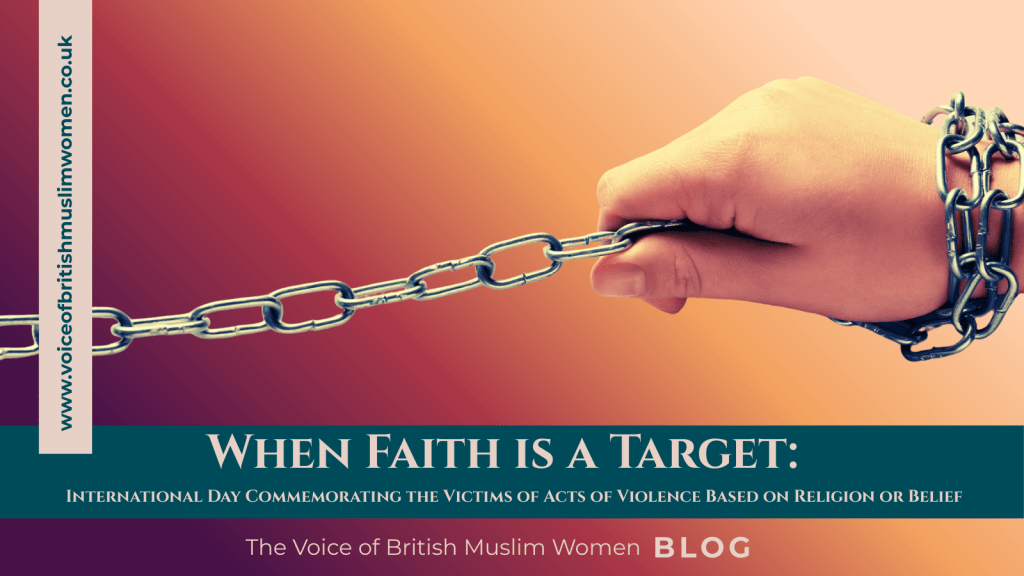
International Day Commemorating the Victims of Acts of Violence Based on Religion or Belief
Bareera Ghaffar, Nottingham
The right to religion. The right to practice as one chooses, is a human right. The Universal Declaration of Human Rights in articles 18,19 and 20 depicts how people across the world have a freedom of religion, expression and opinion. People have a right to gather and these groups, though different, are connected in their right to exist and therefore strengthen one another. Many across the Globe, in fact 88% of the world’s population identify with a religious group. There are others who don’t align with any particular religious group or believe in a Higher Power altogether and they too have a right to do so and to manoeuvre through the world we all share without fear. With or without religion people have a right to a livelihood, safety and a right to be. There should not be, categorically, any reason why people should fear for their lives due to their religion, there should not be any reason why people living in the land in which they were born, should feel like they don’t belong or are driven out due to their religious beliefs.
If this is the case, if groups are targeted, harmed, persecuted and thus ousted from places and countries due to religious beliefs, then the rights of ALL religious beliefs are at risk and that should be alarming.
Individuals turn to religion for a number of different reasons, for example for peace and a sense of security especially in this ever-changing world. However, bigotry and control exercised by others targets them in their quest for peace which leads to persecution of varying levels. From the divide of Catholics and Protestants in Northern Ireland to the ongoing persecution of Uyghurs in China, violence against people due to their religion and belief persists at increasing rates and as stated, in varying degrees. They are all victims and therefore must be acknowledged and supported. The Holy Quran so clearly illustrates how people should act in case of differing beliefs, Chapter 109, Al Kafirun states “‘I worship not that which you worship; ‘Nor worship you what I worship ‘And I am not going to worship that which you worship;‘ Nor will you worship what I worship. ‘For you your religion, and for me my religion.”
The victims of such tragedies face it from all sides, their homes, businesses, properties, schools, places of worship, any such thing that holds great significance to them is under attack. The Universal Declaration of Human Rights has strongly deplored that attacks on all such places is a violation of international law. When one thinks of the persecution of early Muslims, it brings tears to the eyes. The persecution of the early Muslims was systematic; physically, economically and psychologically, they faced all sorts of heinous acts of violence. Take the event of the Siege of Abi Talib alone, that lasted nearly 3 years which caused starvation and extreme hardship for the Holy Prophet (peace and blessings of Allah be upon him) his family and Companions.
The barbaric acts of persecution inflicted on Hazrat Bilal (may Allah be pleased with him) in Mecca were horrific. Yet he and other Muslims in Mecca, showed immense bravery and were incredibly steadfast. When the Hijrah or migration took place and the Muslims moved to Medina, the Holy Prophet (peace and blessings of Allah be upon him) put together the groundbreaking Constitution/Charter of Medina, which highlighted the rights as well as responsibilities of the Jews, Muslims and pagans living there and how they could do so peacefully.
Islam, through the Holy Quran and the Sunnah of The Holy Prophet (peace and blessings of Allah be upon him) showcases the love and unity that comes with religious liberation and upholding the rights of others through kindness and mutual respect. In a world where bloodshed and violence prevail, the sacred act of gentility is an act of rebellion.
The Ahmadiyya Muslim Community has faced persecution due to its religious beliefs. From the parliament of Pakistan declaring Ahmadis outside the fold of Islam in 1974 and making it punishable by law for them to engage in any religious acts, to the execution of 9 worshippers in Burkina Faso in January 2023, many Ahmadis across the globe have faced persecution and given their lives for their beliefs. Indeed, The Holy Quran states “… whosoever killed a person… it shall be as if he had killed all mankind;…” (5:33)
Do the hearts not tremble at such injustices?
Do the hands not falter?
Do the eyes not weep to be a witness?
Do the ears not shatter from the cries?
Does the soul itself not weaken?
 Voice of British Muslim Women
Leave a comment