Yusra Dahri, Tilford
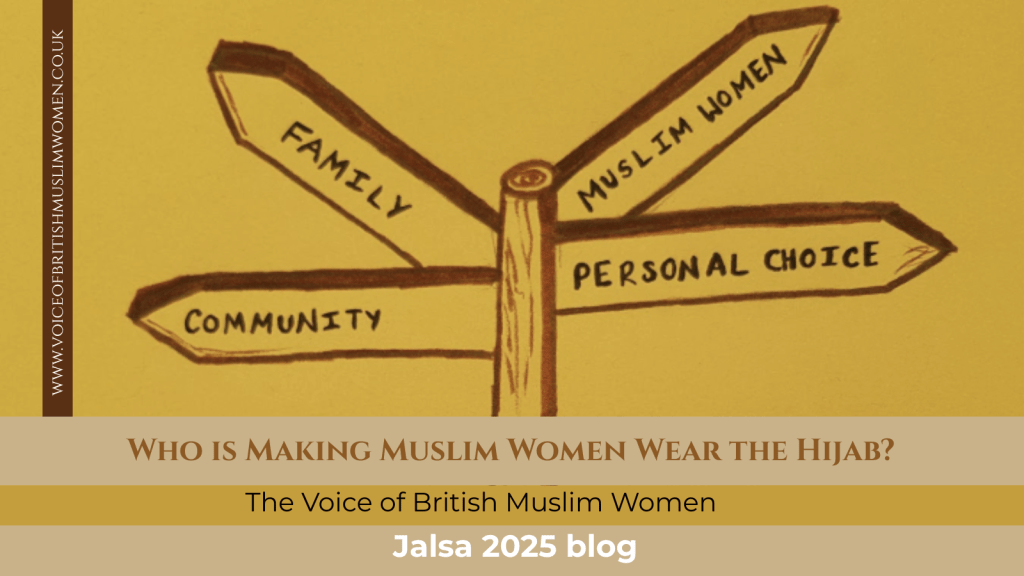
Over the past decade or so, the hijab has remained a contested issue. Even now, only 26% of Britons believe that wearing a hijab is a woman’s personal choice, whereas 49% believe Muslim women wear the hijab due to family or community pressure.
As a woman who wears the hijab of her own volition, I would like to pause for a moment on the issue of the hijab and instead ask the British public, including British Muslims: what does it mean to have personal choice? In the age of the Internet, our behaviour is governed by the micro-trend. We buy new clothes, things we know we won’t keep, just to donate, resell, or throw them away. Are we doing this out of personal choice, or poor impulse control? Not only clothing but every aspect of our lives, from make-up to studying a Masters, is manipulated by marketing and advertising. In a world of mass production, to what extent is personal choice still personal? In an increasing materialistic society, is free will still free? Is it possible to live a life unaffected by external factors?
With these questions in mind, I would like to return to the issue of the hijab. Women are considered to be the primary drivers of consumer spending, and many industries profit off of creating products that simultaneously assuage and reinforce their physical insecurities. It is harder to profit in this way off of Muslim women, not because Muslim women don’t have their fair share of insecurities, but because a conscious distance between their physical attributes and spiritual personhood has been woven into the fabric of their religion.
At this point, it might likely be asked: well, what about the men? While in Islam, men aren’t required to wear a physical veil, they are commanded to lower their gaze, not only physically but also internally. In a scenario where all parties are sincerely following their religion, the current model of advertising would fall apart, as there would be a lack of a sexualised female body, and a lack of a male gaze. This would lead to young women and girls no longer viewing the objectified female body as aspirational. This is crucial, because a woman, especially a young woman, cannot truly assert her autonomy if she consciously or unconsciously uses her free will to view herself as an object instead of using it to establish a connection with her Creator.
Unfortunately, in both the East and West, the moral and spiritual condition of the world is in a dire state. I am currently at the annual Jalsa Salana, where thousands of Muslims have gathered for the sake of their moral and spiritual improvement. Here, I am surrounded by thousands of Muslim women who use their ears to listen, their mouths to pray, their hearts to love, their hands to serve, and their minds to choose. I love this country, and welcome every choice it makes towards seeing Muslim women for who they truly are.
 Voice of British Muslim Women
Leave a comment