Nooresahar Ahmad, Hampshire
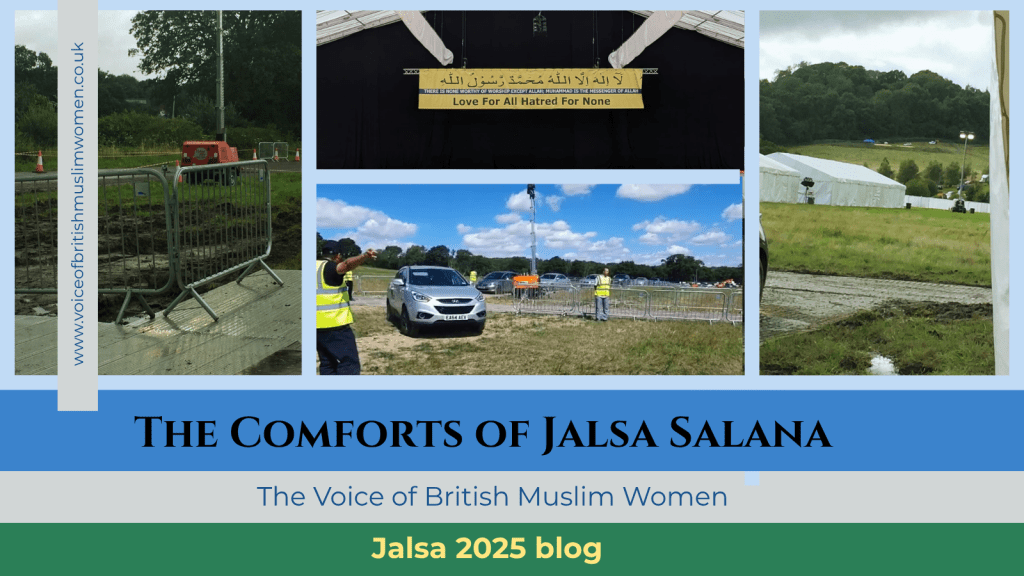
I have a distinct memory of a particularly rainy Jalsa that I attended when I was about 14. That year, I was doing water duty, and one of my major tasks was delivering a red cart loaded with water bottles at different tents around the site. I wore tall pink wellington boots and a plastic poncho that somebody gave me, which kept me somewhat dry. Despite my best efforts at protecting myself from the elements, however, I ended up with a thick stripe of mud across my white shalwar trouser that I was never quite able to wash out.
During one of those trips with my cart, I had watched in fascination as troops of women squelched their way across the site. I was particularly absorbed by one woman, who was wearing flimsy sandals (a significantly different choice in footwear from mine). With each step, her foot would sink about an inch into the mud, and she, uncaring, would pull it out and continue walking.
That was not, of course, the last rainy Jalsa. 2021 was another one, the first Jalsa after COVID and my brother Syed Taalay Ahmed Shaheed’s last. He took footage of men on car park duty pushing vehicles out of the mud late into the night, and turned it into a short video for MTA, which ended with the words: ‘Thank you, car park heroes’.
At Jalsa Salana UK, the set-up of the Jalsa site, which consists of a series of marquees in the countryside rather than a set of buildings in the city, means that sometimes the question of physical comfort is brought to the fore. As these memories bear testament to, we are rather exposed to the elements at Jalsa: if it’s sunny, you will be hot. If it rains, you will get wet.
Yet two things stand out to me about these memories. Firstly, the determined attitude of that woman in sandals, who was not perturbed by the weather at all. One way of remaining comfortable, after all, is by refusing to be discomfited by your circumstances and instead adapting to them while maintaining a positive attitude. The second thing that stands out to me is the way my brother drew my attention, and I’m sure the attention of others, to the people on duty who were working hard, and doing so cheerfully. They prioritised the comfort of other people over their own comfort, as Huzoor (His Holiness Mirza Masroor Ahmad, worldwide head of the Ahmadiyya Muslim Community, may Allah be his Helper) always reminds duty-holders at Jalsa to do.
Jalsa is a kind of microcosm of society and, like all societies, our comfort there is massively dependent on the efforts and works of others. In turn, it is our job to make sure we can enhance the comfort and ease of others as much as possible. This is especially significant when it comes to making sure that the most vulnerable are able to attend comfortably. With each year that passes, under the guidance of Huzoor, (may Allah be his Helper) it seems that each Jalsa becomes even better organised to cater to these needs. This year, for example, the mothers and children marquee will be close to the amenities marquee, which will have milk warming and hot water facilities available, as well as a private space for nursing mothers. Then there are the access arrangements for disabled attendees, which begin with special parking passes and continue to the SEND marquee on-site.
A large event like Jalsa Salana is beholden to many factors, not least the British weather. But whatever happens, so many people work hard to make things pass smoothly for others, that they may enjoy the many comforts that can be taken from the event. These include getting to see beloved friends and family, tucking into a burger from the bazaar, or feeling a sense of fulfilment from doing duty and helping other people. Yet there is one ultimate and truest form of comfort that we go to Jalsa to seek, that we hope to find come rain or shine, and it is explained to us in the Quran: ‘Those who believe, and whose hearts find comfort in the remembrance of Allah. Aye! it is in the remembrance of Allah that hearts can find comfort;’ [13:29].
 Voice of British Muslim Women
Leave a comment