Sarah Ward
In the bleak midwinter, frosty wind made moan,
Earth stood hard as iron, water like a stone;
Snow had fallen, snow on snow, snow on snow,
In the bleak midwinter, long ago.
These words echo in my memory. Words from my childhood and days of singing in the school choir. In amongst the religious songs sung to celebrate Christmas, these few lines represented something different to me. They spoke of nature, reflecting realities to me and the poetic imagery has lodged in my mind. Winter was bleak, daylight was sparse, and the temperature sent everyone indoors. Not my favourite time of year. But my parents felt differently; they were of the firm view that ‘you are closer to God in the garden than anywhere else on Earth’ and so rain or shine, summer or winter they were out tending their plants. Needless to say, in winter, I did not care to join them; curling up by a roaring fire with a good book was a much more appealing prospect. But summer was a different matter.
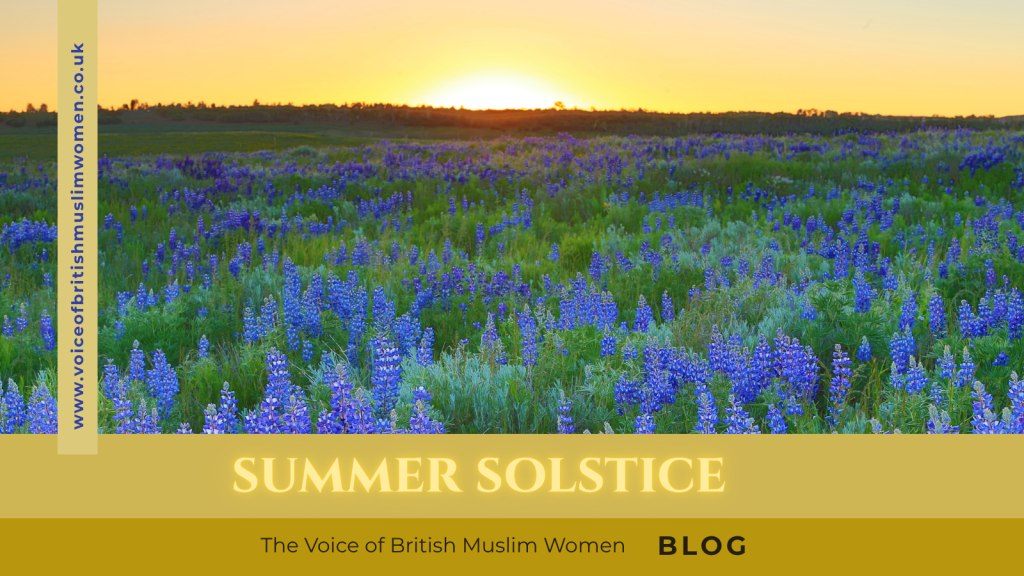
Summer days are always associated with light-heartedness, joy, and overabundance of energy. The natural flora of the UK is verdant, lush and overgrowing on every country road and city park. The re-birth is obvious, colourful and fragrant – who wouldn’t feel joy to be basking in the warm sun after a long, dark winter? It’s well documented that these physical changes in the world contribute to or have emotional and mental health impacts. Experiencing Seasonal Adjustment Disorder (SAD) has been recognised by health organisations such as the NHS1 and Harvard Medical School2 although the exact causes are still not fully understood. But there is scientific, poetic and spiritual agreement that the changing seasons impact us in myriad and often unseen ways.
Which is why the summer solstice is such an interesting time of year. It is marked by celebration, ceremony and prayers by many people in traditions which are older than many written scriptures. The movement of the sun across the sky, in shorter or longer periods has enthralled people from all areas of the globe for millennia and similarly, Islam acknowledges the significance of this celestial sphere. The Holy Qur’an says:
‘Allah is He Who created the heavens and the earth and caused water to come down from the clouds, and brought forth therewith fruits for your sustenance, and He has subjected to you the ships that they may sail through the sea by His command, and the rivers too has He subjected to you. And He has also subjected to you the sun and the moon, both performing their functions constantly. And He has subjected to you the night as well as the day. And He gives you all that you ask of Him, and if you try to count the favours of Allah, you will not be able to number them.’3
The sun is described here as a sign of the blessings of Allah, a source of food and a means to find gratitude. A study of the natural systems of the world will always inspire awe and wonder. It happens from the youngest pupils in school, to the oldest among us. The rhythms of nature never fail resonate deeply. The symbolism of winter, spring, summer – the cycles of growth, death, re-emergence inspires hope and an understanding of the finite nature of life itself. It’s a story that explains itself year after year – a physical manifestation of deeply rooted spiritual concepts.
So, what value does the solstice have? Why have so many marked this moment where day and night are equal? Why has the significance of this day remained so long in the popular conscience? For me, it is because it marks a unique moment of hope and reflection. The point at which day and night are in balance. From that point onwards, the sunlight is in decline and the long descent into the darkness of winter begins again. Just as ease follows hardship, so hardship often follows ease. It’s a stark reminder that life is not static, we cannot remain in the same spiritual or physical state endlessly. Change is part of life. Facing difficulty with a smile is an important spiritual skill to develop. It’s a moment to accept the turning point of the year, to pause, to pray and to reflect on whether the year has been successful and ponder what achievements have been made.
The natural cycles of the Earth are a God-given blessing which link firmly with our internal life. But for millions around Britain, the solstice will be another day on the calendar, perhaps nothing notable to many. And just as connecting with the Earth improves spirituality, distance and dislocation from nature can also lead to spiritual decline. So maybe this year, solstice is a perfect moment to reconnect, embrace gratitude and realign our spiritual journey into the darker days ahead.
References
1. https://www.health.harvard.edu/newsletter_article/shining-a-light-on-winter-depression
2. https://www.nhs.uk/mental-health/conditions/seasonal-affective-disorder-sad/overview/
3. https://new.alislam.org/library/books/quran-english?option=toc&page=376
 Voice of British Muslim Women
Leave a comment