Maria Sadaf, Islamabad
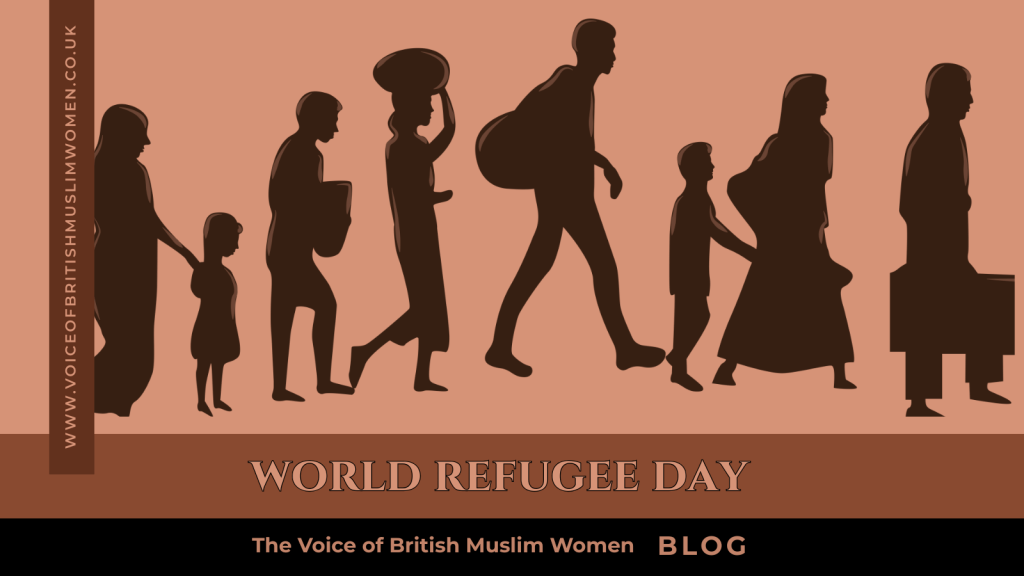
Every year on June 20th, the world observes World Refugee Day, a day dedicated to raising awareness of the plight of millions of refugees across the globe who have been forced to flee their homes due to war, persecution, and natural disasters. As of 2025, the number of forcibly displaced people globally has surpassed 120 million, with over 36 million classified as refugees (UNHCR, 2025). This humanitarian crisis demands not only political solutions and global cooperation but also a renewed commitment to compassion, justice, and moral responsibility—principles deeply rooted in Islamic teachings.
Recent crises underscore the urgency. In Palestine thousands continue to be displaced amid violence and blockade (UN OCHA,2024). In Sudan, a brutal civil conflict has created a mass exodus (Norwegian Refugee Council, 2024). The war in Ukraine has triggered displacement across Europe, while the Rohingya remain stateless in refugee camps in Bangladesh (Human Rights Watch, 2024).
In face of such widespread suffering, faith traditions offer vital moral guidance. Islam, for instance, provides a robust moral framework for how refugees should be treated – with compassion, dignity, and shared humanity. The Holy Qur’an highlights the noble example of Ansar (Helpers of Medina) who received the Muhajirin (refugees from Mecca) during the Holy Prophet’s (peace and blessings of Allah be on him) migration. In chapter 59, verse 10 of the Holy Qur’an, God praises the Ansar:
“And those who had established their home in this city before them and had accepted faith, love those who came to them for refuge… prefer others to themselves, even though poverty be their own lot…”
This verse celebrates the extraordinary selflessness and solidarity shown during the migration (Hijrah) – one of Islam’s most important historical events – where the Holy Prophet (peace and blessings of Allah be on him) and his followers fled persecution. The Ansar welcomed the refugees from Mecca not as strangers but as brothers, sharing their homes and livelihoods. It remains a timeless model for all who seek to support the displaced.
This example was not isolated but deeply rooted in the broader Islamic emphasis on compassion, justice, and protection of the vulnerable. The Holy Prophet (peace and blessings of Allah be on him) personally taught and exemplified these values, urging support of the oppressed regardless of faith. When early Muslims faced persecution in Mecca, he sent them to Christian Abyssinia under the rule of the just King Negus, acknowledging that justice and safety should be the foundation of governance regardless of religious affiliation.
Building on these enduring Islamic principles, His Holiness Mirza Masroor Ahmad, Worldwide Head of the Ahmadiyya Muslim Community, (may Allah be his Helper) offered a powerful perspective on the immigration crisis during his address at the 43rd Annual Convention, Jalsa Salana, of the Ahmadiyya Muslim Community in Germany on 8th September 2018. He emphasized that while the “priority should be to try to reconcile the peoples of those nations and to end wars,” if peace cannot be achieved immediately, then “it is our moral duty to open our hearts to those who are genuinely suffering.”
He called on societies to embrace compassion over rejection, stating that “we should be there to give a helping hand to those whose lives have been broken… who are utterly helpless, vulnerable and defenceless.” His powerful appeal “Let us prove our humanity. Let us show our compassion” underscores a moral obligation to support innocent victims of conflict.
At the same time, His Holiness placed responsibility on the immigrants themselves, urging them “to contribute to their new society… serve their adopted home and work towards its continued development.” He advocated for integration, not isolation, and encouraged harmonious coexistence between diverse communities.
Together, his message calls for mutual empathy, social responsibility, and practical steps towards lasting peace – a balance of humanitarian compassion and civic accountability.
As global instability continues, the refugee crisis will remain one of the defining challenges of our time. But by anchoring our response in faith, ethics, and the prophetic model, we can offer not only relief but also hope, healing, and humanity.
Let this World Refugee Day be a reminder – to be Muslim is to stand with the displaced, the downtrodden, and the forgotten -not with apathy, but with action.
References
UNHCR. (2025). (Statistics)
UN OCHA. (2024).
Norwegian Refugee Council. (2024).
Human Rights Watch. (2024).
The Holy Qur’an, Surah Al-Hashr, 59:10. Translation by Maulvi Sher Ali.
Five volume Commentary. Al-Hashr, 59:10
Hazrat Mirza Masroor Ahmad, Address at Jalsa Salana Germany, September 8, 2018. Muslim Migrants and Integration.
 Voice of British Muslim Women
Leave a comment