Nooresahar Ahmad, Hampshire
In Valencia, eastern Spain, the Araña caves contain two examples of prehistoric rock art, composed by hands that perished thousands of years ago. In one, a goat is hunted with a bow and arrow. The other depicts a scene of a woman atop a ladder which rests on a cliff face, her head level with a small, dark opening in the rock. She holds onto the ladder with only one hand — the other holds a pot. Four or five bees, each bigger than her head, hover around her. It is this painting that makes the Araña caves so significant; it is the earliest known depiction of bees, and the oldest evidence of honey collection and consumption.
Although the painting is simple, the difficulty of the woman’s endeavour is made clear from the precariousness of the ladder, the distraction of the bees, her tenuous grasp. Modern honey farming seems significantly less dangerous in comparison, but there are still those who are willing to go to extreme lengths to find honey. In Nepal, for example, the Gurung community use techniques passed onto them from generations of honey collectors to scale the steep Himalayan cliffs, and extract honey from the wild bee hives that can be found there.
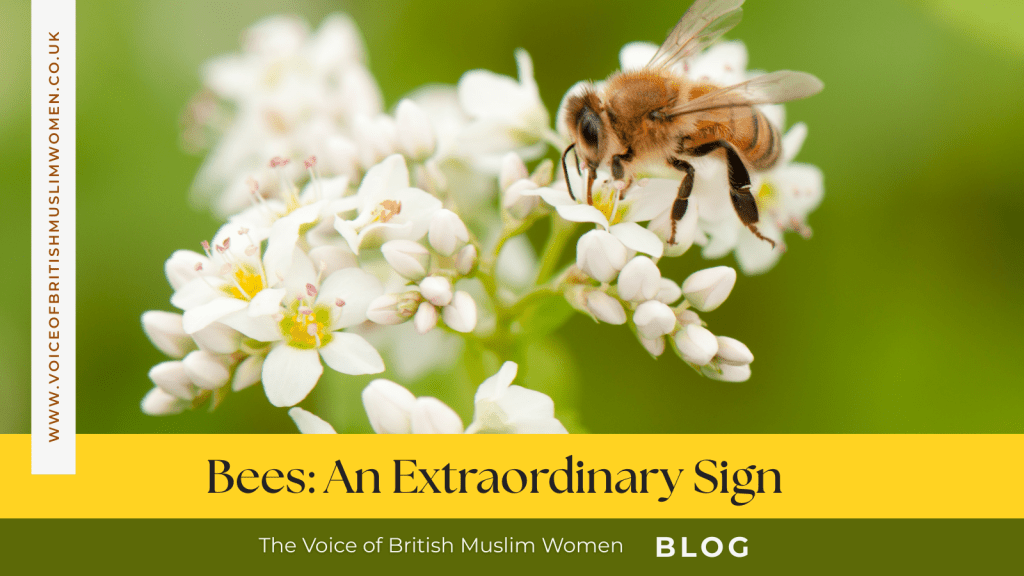
Can honey be worth such perilous feats? Though sweet tasting, can it be worth the effort and risk of such a climb? According to Islam, it may well be. In the Holy Qur’an, not only is honey described as a precious cure for ailments and illnesses, but bees are described as divinely guided creatures, evidence of the intelligence and beauty of God’s creativity:
“And thy Lord has inspired the bee, saying, ‘Make thou houses in the hills and in the trees and in the trellises which they build. ‘Then eat of every kind of fruit, and follow the ways of thy Lord that have been made easy for thee.’ There comes forth from their bellies a drink of varying hues. Therein is cure for men. Surely, in that is a Sign for a people who reflect. [16:69-70]”
His Holiness, Mirza Tahir Ahmad, (may Allah have Mercy on him) the fourth Caliph of the Ahmadiyya Muslim Community has elaborated on this verse: ‘Of all the insects which pervade the world, God has picked just this one to demonstrate that when He communicates with an animal belonging to an ordinary species, how its status is lifted beyond comparison to that of the other members of the same species. What is a honey-bee after all, but a fly. Yet what a fly!’ Through God’s command, he explains, it has become ‘a source of healing and cure, unlike other insects which carry and spread disease.’ [i]
Since the revelation of the Holy Qur’an some 1400 years ago, we are even more aware of the importance of bees. Their process of collecting and spreading pollen enables plants to reproduce, making them a key part of our ecosystem. We are not only dependent on bees for a dash of something sweet in our cups of tea; we are dependent on them for our survival.
Yet today the bees in Britain, and beyond, are in danger. The intensification of farming, climate breakdown and habitat loss have resulted in a serious decline in bees in the UK; we have already lost around 13 species, and 35 more are at risk. Even as the reckless actions of humanity put their lives in peril, it is clear we are as dependent on bees as ever: it would, for example, cost UK farmers £1.8 billion to pollinate their crops without them. This may, however, eventually become our reality, as the decline of bees becomes an increasingly pressing matter. Even the Gurung community of Nepal, for example, have noted that the number of hives in the Himalayan cliffs have declined so significantly in the last decade or so, that they have had to turn to other ways of farming to make a living. Somehow, it is not the hazard of a sharp drop, but the impact of climate change, which are forcing these honey collectors to turn to rice and wheat farming.
On this World Bee Day, then, we would do well to heed the words of the Holy Qur’an, which present bees as the epitomic example in nature of resourcefulness, creativity and hard work. From them we can learn the genius of Allah’s design, as well as important lessons in how to build our own communities which — instead of being wasteful and chaotic — are as organised and industrious as the bees’.
 Voice of British Muslim Women
Leave a comment