Danila Jonnud, Hampshire
When I found out about World Hello Day, funnily enough, the first thing that came to mind was a scene from the CBBC show Horrible Histories which I loved watching as a child. The sketch I remembered featured a fictionalised re-enactment of the first telephone call, where the recipient was so surprised at the phone working, he exclaimed “Hello!” as an expression of astonishment, the most common use of that word at the time. In fact, I believe Alexander Graham Bell wanted to popularise ‘Ahoy’ as the greeting at first, but ‘hello’ came to be upon the suggestion of Thomas Edison.
As a student studying literature and language, greetings are obviously quite interesting to me. For example, in Japan, they answer the phone with もしもし [“moshi moshi” – literally “I speak, I speak”] a greeting only used for that purpose, much like Edison’s intention for ‘hello’. As anyone who’s studied a language will know, one of the first things you learn is introductions and greetings. When I began learning Mandarin during my second week of university, we naturally began with the greeting 你好! [Nǐ hǎo!/Hello!] and learnt how to respond to introductions with 认识你很兴! [Rènshí nǐ hěn gāoxìng! / Glad to meet you!]. What’s interesting is that, despite learning this, I’ve been told it’s mainly used in formal settings, especially when people aren’t that close or are strangers.
This makes me think of when I have to begin emails, or message someone I don’t know that well. Whenever I do, I always spend time considering whether Good Morning/Afternoon/Evening, Hi, or Hey is the most appropriate for the required formality – despite being told by teachers and family alike when younger that “hay is for horses”!
All in all, I hardly ever use the word hello. Maybe it’s a generational thing, but after the first half term of constant ice breakers and small talk, I can safely say that my most used words when meeting people were probably “Hi” and “What course do you do”, which I’m sure a lot of students would relate to.
Of course, Japanese, Mandarin, and English aren’t the only languages I’ve ever been exposed to. Being bilingual (or so I like to think), the greeting I use most at home is the Arabic “Asslaam o alaikum” [Peace be on you].
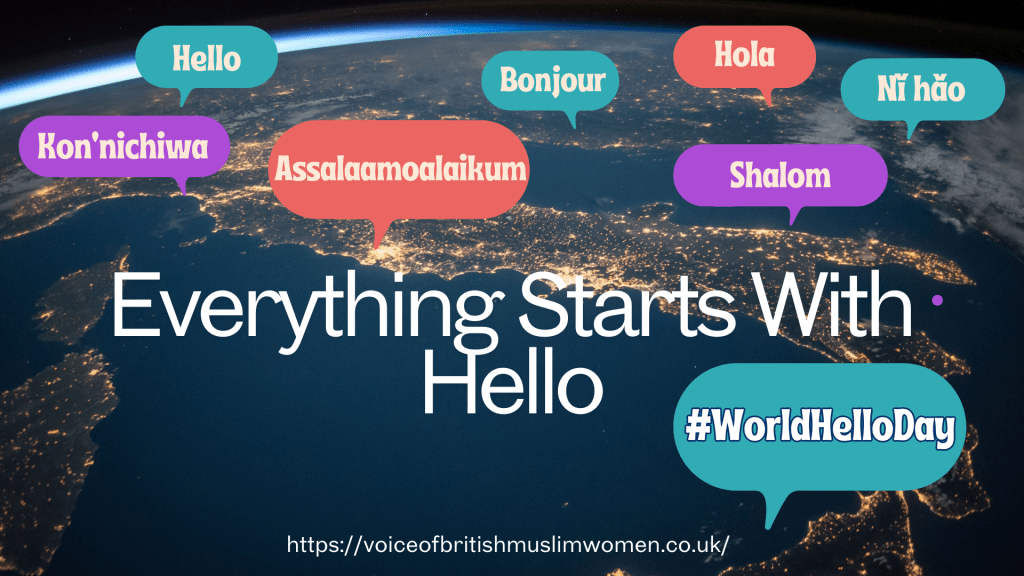
You might call me biased, but I kind of like that greeting the best. For one thing, in Islam, the person who greets first is said to receive special blessings; I’ve grown up with my granddad always making sure that he says “Assalamualaikum” first wherever he goes. For another thing, whether it’s a stranger, family member, friend, colleague; adult, child, one person, or a crowd, this greeting doesn’t change. The meaning has always remained the same, since its inception. It’s not that I like it best just because I’m a Muslim (the Jewish greeting of “Shalom” is a variation of it too), but because I’m a student of language and comparison, and also simply because I’m human.
And it’s interesting because World Hello Day was established to promote peace and communication by encouraging people to do the simple act of saying “hello”. Created in the aftermath of war as a reminder of the importance of fostering understanding between peoples, it’s a commemorative day which I’m truly glad I learnt of, because I really believe in the power of language. And wishing peace on whoever you meet – as is the sentiment of today – is in my view, very powerful.
‘Hello’ began life as an expression of surprise. With technology developing, it became a word for the phone, signalling that someone wanted to speak, especially when it came to business deals. Now, it’s synonymous with the very idea of a greeting. In its modern sense, without referring to history, it can’t be broken down; it has purely secular, Old Germanic and French roots and doesn’t indicate a specific feeling or anything, the way ‘Good Morning’ might. If you want to translate a greeting from another language into English (as I did earlier with “Nǐ hǎo!”), you have the all-purpose ‘Hello!’ at your service. It’s a comfortable, safe, friendly word – and it just means ‘Hello’.
But, somehow, isn’t it so much kinder and prettier, so much more amazing, to wish peace on someone? I mean, no matter who they are, or how well you know them, the Arabic greeting is a statement invoking upon the recipient the highest form of contentment, the most blissful state of existence possible in our human thoughts and languages. It’s a personalised version of most celebrities’ answer to the “What do you wish for most?” question – rather than the enormous feat of ‘world peace’ (though don’t we wish it wasn’t a feat) it’s quite simply, “on you”.
It reminds me of a quote I used to see on school display boards, or motivational social media accounts:
“Be kind. For everyone you meet is fighting a hard battle.”
To be honest, well-meaning though it may be, I have no idea if my “good morning” was said to someone who maybe wasn’t so good. That doesn’t mean I shouldn’t say it, or that I need to overthink my greetings, but, if I really wonder about it, I simply don’t know. And someone who says it to me has no idea if I’m good either.
The point is, and it’s true that this is just an opinion, but in my view no beginning for a conversation, a speech, or a letter is quite so beautiful in meaning as “Peace be on you”. It’s not a demand which can be petulantly opposed by the recipient in a bad mood. It’s not a statement of something being good when it might be very, very bad. It’s simply a wish, a hope, a prayer. A blessing.
If this was a conversation, I’d probably end with “nice to meet you” or “see you later”. If it was a speech, maybe “thank you for listening”. If it was a letter I might end with “goodbye” – or in fact “God be with ye” as it originally was.
But I want to end it by wishing peace, something we could all do with especially these days, on everyone who might read this.
Asslaam o Alaikum.
 Voice of British Muslim Women
Leave a comment