Ayesha Naseem Mirza, Walsall
In school, we regularly learnt about the British values of respect, tolerance, democracy and freedom. Teachers drew constant attention to these values and how we should all try and emulate them in our daily life. It is only with more education, experience of the world and the way people and societies around us function that we come to understand the significant meaning of these words.
Tolerance is quite an interesting concept. Simply, it means having the ability to tolerate and to allow and respect the existence and practice of something even if it is different to your own beliefs or point of view.
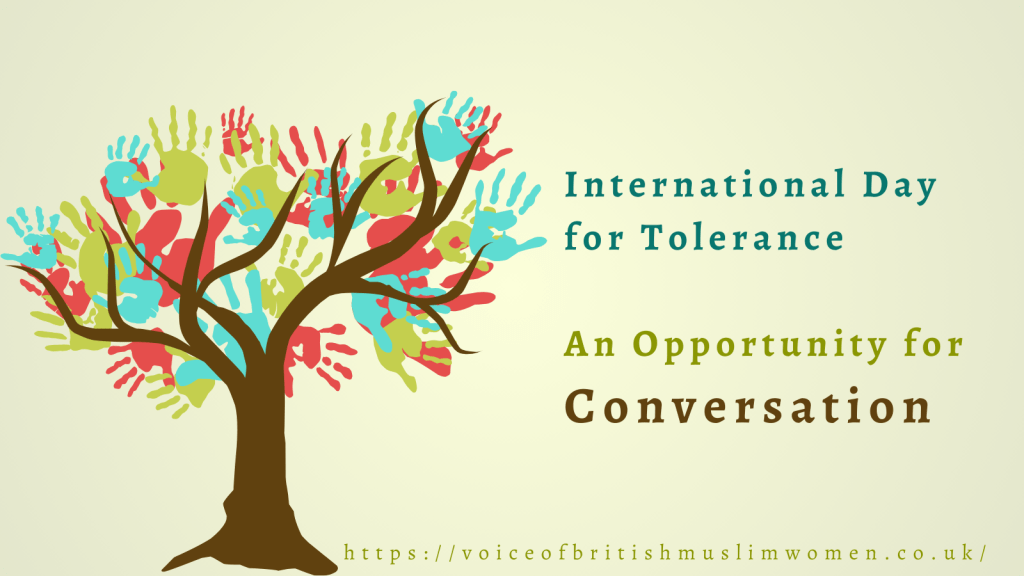
In 1996, the UN General Assembly adopted Resolution 51/95 declaring 16 November to be observed as the International Day For Tolerance. In the year prior to this proclamation, United Nations Educational, Scientific and Cultural Organization (UNESCO) published the Declaration of Principles on Tolerance which states: “Tolerance is respect, acceptance and appreciation of the rich diversity of our world’s cultures, our forms of expression and ways of being human.” [1]
Tolerance is not indifference or silent agreement, however. You can be tolerant and accepting of others and their views yet still have progressive conversations. Despite disagreement and difference, tolerance can invoke and initiate dialogue, conversations and can enable a space for awareness and a sharing of ideas.
Islam also promotes tolerance. Addressing the National Peace Symposium in 2006, the fifth Caliph and the current worldwide head of the Ahmadiyya Muslim Community, His Holiness Mirza Masroor Ahmad (may Allah be his Helper) stated:
“I would like to say that the very name ‘Islam’ contains an antidote for cruelty, the inability to put up with others and the absence of tolerance… One meaning is peace, another meaning is submission and obedience, yet another is making peace and achieving reconciliation. One meaning is to leave someone when he is likely to cause you harm, another meaning is to walk together in harmony. The purpose of telling you about these definitions of the name of Islam given by God Almighty to this religion is because the sum total of its teachings and the Muhammadan Laws include within it love, tolerance, endurance, and freedom of conscience and speech and the right to express an opinion.” [2]
On 19 October 1924, the Second Caliph of the Ahmadiyya Muslim Community, His Holiness Mirza Bashir-ud-Deen Mahmood Ahmad (may Allah be pleased with him) laid the foundation stone of the first purpose-built mosque of London, Fazl Mosque, in Putney.
On this occasion, His Holiness, the Second Caliph (may Allah be pleased with him) addressed the attendees and stated:
“Nothing has damaged unity as much as the fact that some people adopt coercive methods in the name of establishing unity that are completely contrary to their stated objective. Paradoxically, the pursuit of unity and societal cohesion has suffered far greater injury from its misguided allies than from its adversaries. Therefore, a person must always exhibit tolerance and respect.” [3]
A hundred years later, the fifth and current Caliph of the Ahmadiyya Muslim Community, His Holiness Mirza Masroor Ahmad (may Allah be his Helper) addressed guests at the event marking the centenary of the laying of the foundation stone for the Fazl Mosque. In his address, His Holiness quoted extracts from the address of the Second Caliph and emphasised that in a time when intolerance and indifference is rife and while the future of the world is at stake with the rapidly increasing wars, there is an ever-increasing need for society to adopt respect, tolerance and unity.
There is a general trend in the world nowadays where there is very little patience and very little effort to agree to disagree. And in a world so polarised as the one we are currently living in, observances of days like International Day For Tolerance become increasingly important.
Just as the purpose of UNESCO is to utilise arts, science, culture and education to focus and promote peace in the world, the observance of the International Day For Tolerance provides us, as members of society, with an opportunity to start conversations that can otherwise seem difficult. We can direct our focus and bring awareness on the conflict in Gaza, Lebanon and the wider Middle East as it gets lost in the mainstream media and becomes a thing on the side; we must not let indifference and apathy overpower the scale of destruction and man-inflicted suffering to human life. This is to be acknowledged as ultimately, as Muslims, and as members of British society, the values of freedom, diversity and tolerance are of utmost importance and duty.
References
[1] https://www.unesco.org/en/days/tolerance
[2] https://www.alislam.org/articles/freedom-of-speech-and-tolerance-in-islam/
 Voice of British Muslim Women
Leave a comment