Nooresahar Ahmad, Hampshire
‘What is history?’ asked the second Khalifa of the Ahmadiyya Muslim Community, His Holiness Mirza Bashir-ud-Deen Mahmood Ahmad (may Allah be pleased with him), in an address at the inauguration of a women-only college in Rabwah in 1951. ‘History,’ he asserted, ‘tells you who your father was, who your paternal grandfather was, who your mother was, and who your maternal grandmother was. History tells you who your forefathers were and who you are today. […] if there is any worldly subject worth fighting to acquire, it is the subject of history.’1 All markers of time passing, such as anniversaries, are a good opportunity to reflect on our history. At last year’s National Lajna Ijtema we commemorated 100 years of Lajna Ima’illah, which involved looking back on our history, from the inauguration of the institution by the second Khalifa, to the work put in by Lajna over the years so that it could flourish.
In his address, the second Khalifa was highlighting that there can be no understanding of the way things are today, without understanding the way things were different in the past. I recently asked my mother what the Lajna UK Ijtemas which she attended in her youth were like. The first thing she said was, ‘they were nothing like they are now.’ They were much smaller, she said, held in a single marquee or hall, and those in attendance did one of two things: either they competed, or listened to those who were competing.
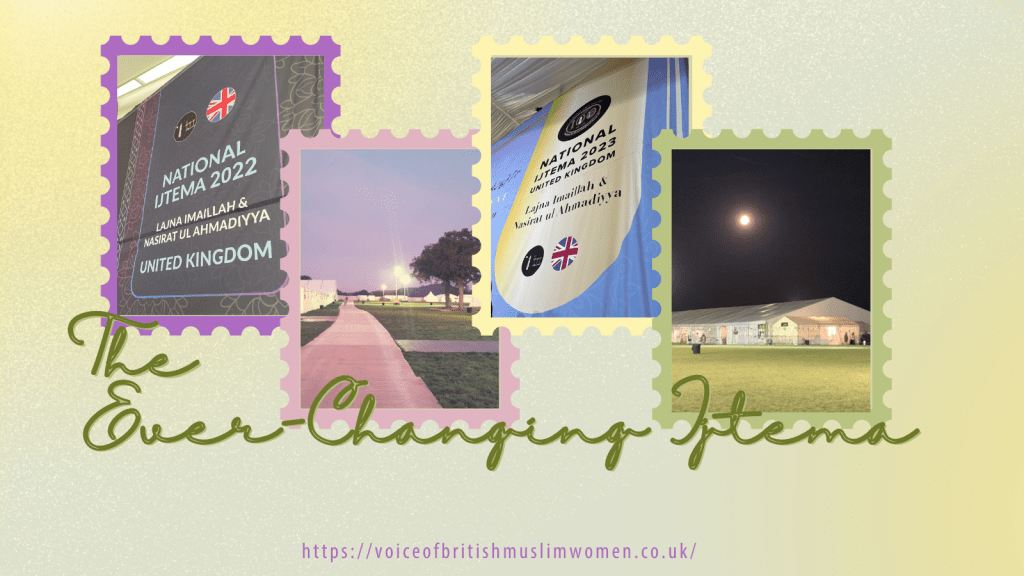
In the past couple of decades which make up my own lifespan, I have also seen many changes to the Ijtema space and programme. Just a handful of years ago, the Lajna Ijtema transformed into what I immediately thought of as a ‘mini Jalsa’ — a series of marquees set up in the middle of the countryside. I wandered around, almost bewildered by the sudden enormity of the event, the main marquee stretching out to accommodate thousands of Lajna, other marquees boasting exhibitions, another space for food, a bazaar — and was that an ice cream truck?
But we become used to novelty all too quickly. It seems natural now that the Lajna Ijtema should be a bustling hub, a series of spaces to explore, that one tent hosts an AMWSA (Ahmadiyya Muslim Women Students’ Association) event for students that another showcases an arts and crafts exhibition, that there could be a bouncy castle for Nasirat to jump on. We expect poetry competitions and presentations on thoroughly-researched topics, both secular and religious. We aren’t surprised when the number of attendees, a number in the thousands, is read out at the event. It is only when we remember to look at the history of the event, that we become startled to think of how much Lajna Ijtema has changed.
Looking back at the past not only helps us to understand our present, but also our future. When it comes to considering how the Ijtema could change in the future, we have the words of His Holiness Mirza Masroor Ahmad (may Allah be his Helper) to guide us. At the last Ijtema, His Holiness referred to the future of Lajna as ‘a blank page now [lying] before you in the shape of the coming century.’ And it is, he pointed out, our ‘conduct and standard of faith [which] will determine what is ultimately written upon it.’2
 Voice of British Muslim Women
Leave a comment