Nooresahar Ahmad, Bordon
At the first Jalsa Salana, held in Qadian in 1891, the Promised Messiah, His Holiness Mirza Ghulam Ahmad (peace be on him) announced that, ‘Three days of every year should be fixed for a gathering in which all my devoted followers should — God willing — be present, with the condition of health, time and absence of strong impediments.’ When dwelling on the topic of this blog — ‘Lajna space at Jalsa’ — I find myself returning to two words from this quote: ‘be present’.
Though one’s presence does not always need to be physical (since COVID, it has of course become a norm to attend events virtually), and though many people participate in Jalsa Salana UK by watching it through MTA, there is an undeniable physical element to the convention. By 1892, the second year that the Jalsa took place, the event had become known among those attending as ‘the big Jalsa’. It was held next to the pond in Qadian, and the stage was built from mud collected in and around the pond. Making the most of physical space, whatever the conditions may be, is a core part of the Jalsa tradition.
This is something that stands out in press coverage of the event from years gone by. Before COVID, reporters often emphasised the scale of the Jalsa; headlines often labelled it the ‘largest Muslim convention’, and articles detailed the ‘200 acre farm’ where the Jalsa is held, and the guests who had arrived from ‘110 countries’. One Guardian article from 2016 details the culinary preparations made in the ‘barn-like kitchen’ at Jalsa in a somewhat awe-stricken tone: by mid-morning, notes the writer, 56,000 roti have been baked, and by the end of the day 150,000 will have been made in total.
In 2021, reporters still had a noted fascination with the use of space at the event, but this time for different reasons. COVID made us all aware of the space around us, the proximity between us, the role that indoor and outdoor spaces played in the transmission of the virus. Accordingly, when press coverage of the Jalsa in 2021 mentioned space, it highlighted what had been emptier, or more distant. ‘Marquees on the 200-acre farm are staying the same size,’ notes one BBC article, though this is only ‘to allow for social distancing.’
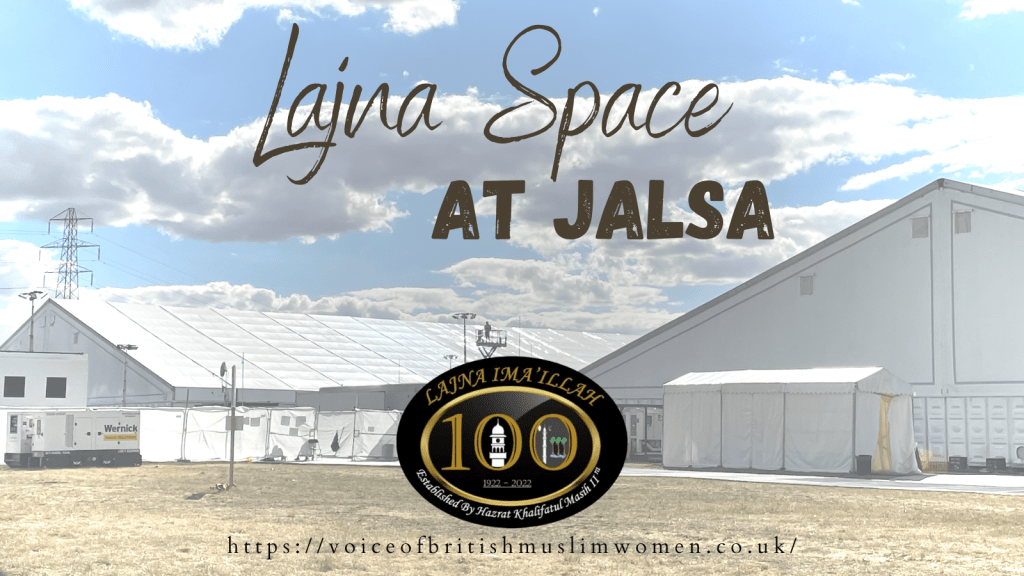
COVID placed restrictions on, and made us hyper-aware of, how we could use our space. Perhaps the memory of those smaller Jalsas will enable us to look at the way Lajna Imaillah uses our site with fresh eyes, and a rejuvenated sense of wonder and regard. For three days, the Lajna site is a bustling hub which distributes food and water, provides accommodation, and organises childcare, exhibition tours, a bazaar. Lajna Imaillah also emphasises inclusivity in our space — demonstrated by an area designed to make the event more accessible for those with special educational needs and disabilities, or the ongoing live translations of the programme into several languages.
The organisation of physical space, when done well, makes it easier for attendees to ‘be present’ — and so it is integral to the spiritual enhancement at the core of Jalsa Salana. ‘If we live to see the 27th December,’ the Promised Messiah (peace be on him) said in his pronouncement at the first Jalsa, having allocated this as the date for the second one to take place, ‘all our friends should, to the best of their ability, come and listen to Divine words and to join in supplication for the sake of Allah.’
References:
https://www.alislam.org/articles/jalsa-salana-history-if-we-live-to-see-27-december/
https://www.alislam.org/articles/jalsa-salana-history-big-jalsa/
https://www.bbc.co.uk/news/uk-england-hampshire-58127967
https://www.theguardian.com/world/2016/aug/12/ahmadi-ahmadiyya-muslims-islam-jalsa-salana-hampshire
 Voice of British Muslim Women
Leave a comment