Nooresahar Ahmad, Hartlepool
“Three days of every year should be fixed for a gathering in which all my devoted followers should – God willing – be present, with the condition of health, time and absence of strong impediments.” – The Promised Messiah (peace be on him), The Heavenly Decree.
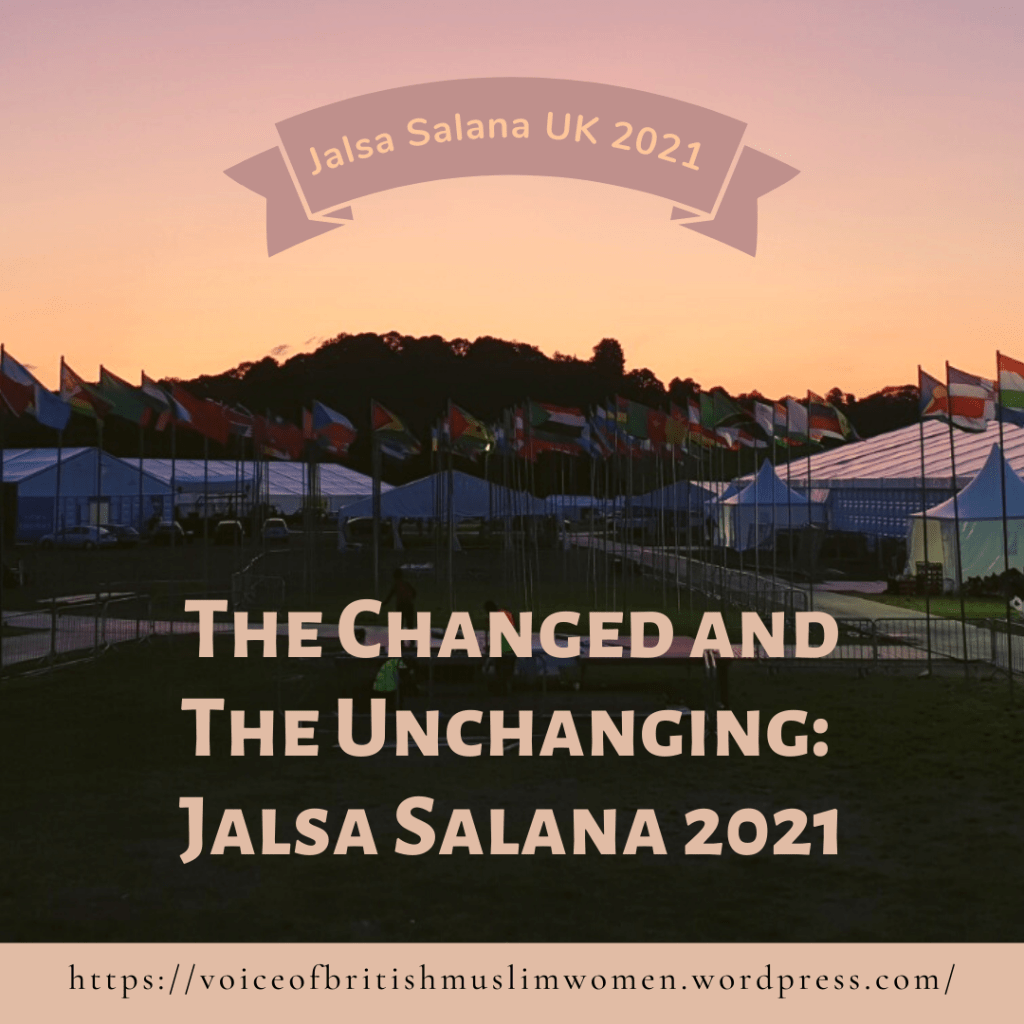
It is no exaggeration to say that Jalsa Salana UK 2021 is like no other that has come before it. Everything, down to the preparation, has been different; normally, I check my bag for my AIMS ID card, a notebook and maybe a snack before leaving. This year, I had to make sure I also had a surgical mask, COVID passport and evidence of a negative lateral flow test.
For many, the usually 3 day event has become a 1 day experience— and for many others, the Jalsa Salana UK is not something they will be able to attend in person this year. By the Grace of Allah, I was granted a pass to attend today (Friday’s) session, and even in person there are obvious differences; everyone is masked, distanced, and the hustle and bustle we have come to associate with Jalsa is absent.
Yet change is not something that is foreign to the Jalsa Salana. After all, the origins of the Jalsa Salana were very different to what many of us have become accustomed to experiencing in Hadeeqatul Mahdi, Alton, in the summer. It began in Qadian, India, on the 27th, 28th, and 29th of December 1891. There were just 75 people in attendance. In 1892, the Jalsa was held next to a pond in Qadian, and the stage was built from mud collected in and around the pond.
Now, of course, Jalsa Salana is held in many countries around the world. Yet even since the Jalsa began in the UK, it has undergone significant transformation. The first UK Jalsa took place on the 29th and 30th August 1964. The organisers at the time faced financial difficulties, struggled with accommodation, and had to figure out how to contact all of the UK Jamaat, which was scattered across the country with no set point of contact. Since then, the event has only strengthened— especially since the arrival of the Khalifatul Masih IV (May Allah have mercy on him) in 1984. It has since been considered an international event, and in 2017, about 37,000 people from over 100 countries attended.
As the opening quote from the Promised Messiah (peace be on him) observes, attending Jalsa Salana is hugely important, but there are some obvious conditions in which one cannot attend. The outbreak of the coronavirus would most likely fall under the category of “strong impediments”. It can be difficult to come to terms with such a change, but since 1891, the primary purpose of the Jalsa has always stayed the same— regardless of location or the number of attendees. And this purpose is, according to the writings of the Promised Messiah (peace be on him), “…to enable every sincere individual to personally experience religious benefits; They may enhance their knowledge and – due to their being blessed and enabled by Allah, the Exalted – their perception [of Allah] may progress.”
The Promised Messiah (peace be on him) also advised that, “…you must not rank this convention in the same league as other, ordinary, human assemblies. This is a phenomenon that is based purely on the Divine Help, for propagation of Islam.” There are countless “ordinary, human assemblies” that we have not been able to access over the last year and a half. Whether you are here in person or watching at home, the Jalsa Salana is not one of them. No doubt thanks to the ardent prayers of the Promised Messiah (peace be on him) for Divine help, the spiritual benefits of the Jalsa are unchanging and accessible to all.
 Voice of British Muslim Women
Leave a comment