Dur-e-Shewar Anwar, Manchester
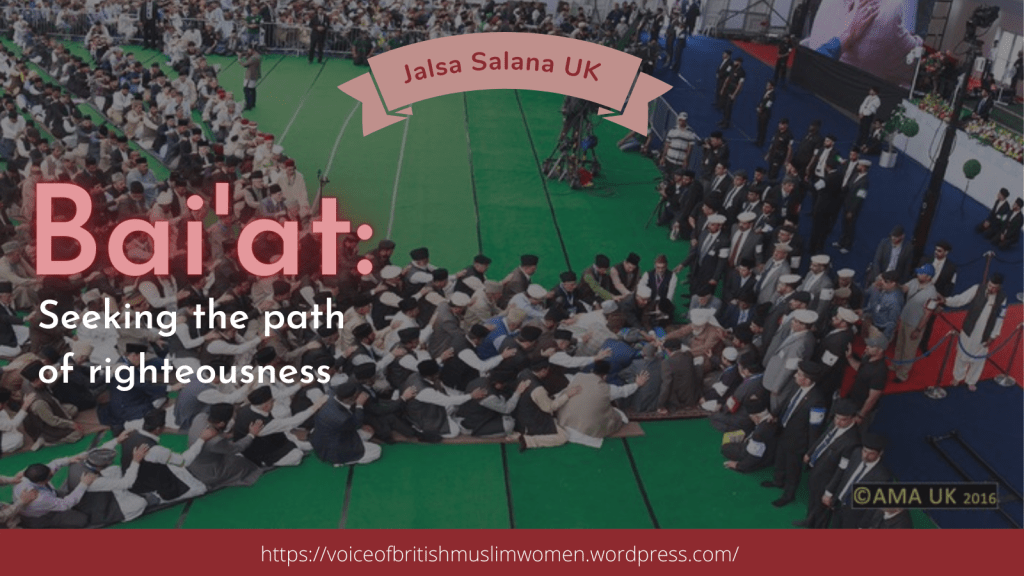
On the Sunday of the Jalsa Salana UK every year, people across the world gather to once again, pledge their allegiance to Islam, Ahmadiyyat, at the hand of His Holiness, the Caliph of the worldwide Ahmadiyya Muslim Community (may Allah be his Hepler). In homes, families huddle close to whichever screen is tuned to MTA where His Holiness’ voice is broadcast. Meanwhile, on a farm in Alton, Hampshire, our beloved Hadeeqatul Mahdi, thousands of people, strangers and relatives alike are seated on chairs, or blankets, or grass; each has their hand placed on the shoulder of their neighbour and they recite the profound words of the pledge in unison.
The tradition of Bai’at, or the pledge of allegiance is an open and formal declaration of faith that dates back to the time and life of the Holy Prophet of Islam (peace be upon him) whence believers would pledge their allegiance to the Holy Prophet (peace be upon him) and the religion of truth and peace that he brought to them. Promising to make every effort to uphold the tenets of Islam; accepting the Unity of God and associating no partners with Him, performing daily Prayers, paying the Zakat and abstain from sinfulness. The Promised Messiah, His Holiness Mirza Ghulam Ahmad (peace be on him) reinstituted the tradition of Bai’at in 1889. A tradition that has been maintained for over 100 years within the Ahmadiyya Muslim Community, with the international Bai’at ceremony constituting a staple of the Jalsa Salana UK.[1]
During the pledge of allegiance, in line with the traditions of the Bai’at that occurred at the time of the Holy Prophet (peace be upon him) and as outlined by the Promised Messiah (peace be upon him) Ahmadi Muslims openly and formally declare our faith in the Unity of God and our sincere intention to make every effort and sacrifice to strive in the cause of this faith. Addressing those who take the Bai’at the Promised Messiah (peace be on him) warned;
“To utter these words is easy, but to do justice to them is hard because Satan is always busy trying to make man careless about his faith. Satan shows the world and its benefits to be within reach, and faith to be distant… If you want to please Allah, put your entire strength and effort to abide faithfully to this commitment of freeing yourself from sins” [2]
The strive for righteousness and Nafs-e-Muhtmainna meaning the soul at rest which is the pinnacle state of spirituality for any believer is not a linear journey. Religiosity wanes and swells throughout the life of a Muslim; as distractions and temptations of the material world impress their influence on believers, it is imperative to have robust reminders of faith. Indeed the Holy Qur’an states in Surah Adh-Dhariyat, verse 56:
“And keep on exhorting; certainly exhortation benefits believers” [51:56][3]
Thus, participation in the annual Bai’at at Jalsa is an emotionally loaded and spiritually rejuvenating exhortation to faith, a reminder of what it means to be a Muslim. The Bai’at and its associated conditions are a concrete measure by which we can reflect on our actions and assess the condition of our souls to discern where we place on this road to God and how we can draw closer to Him.
A distinct feature of the annual Bai’at, that sets it apart from other reminders of faith and reflective opportunities in the daily life of a Muslim, is the emphasis on community. In an announcement in 1889 the Promised Messiah, in describing the objectives of Bai’at, said:
“The system of Bai’at has been established solely to gather together a group of the righteous people… The blessings of being united on one creed may enable them to perform noble and righteous services for the sake of Islam”[2]
Here the Promised Messiah is affirming the concept that there is strength in unity, in a community that is banded together for the same purpose. This is something that is felt in a very tangible way during the international Bai’at ceremony. I recall the last time I was present at the Jalsa during the Bai’at. Sat on the ground in the Garden of the Madhi, reciting the words of Bai’at after my beloved Caliph, I can hear hundreds of other voices ringing in my ears, in incomprehensible languages but all filled with the same emotion and conviction. I am touched and inspired by their faith, which serves only to strengthen my own resolve to strive with even more effort and sincerity for the sake of Islam.
References:
- What is bai’at? By Jalees Ahmad. Al Hakam. Available at URL: [https://www.alhakam.org/what-is-baiat/]
- Conditions of Bai’at and responsibilities of an Ahmadi by Mirza Masroor Ahmad. Available at URL: [https://www.alislam.org/library/books/Conditions-of-Baiat-Responsibilities-of-Ahmadi.pdf]
- The Holy Qur’an with English Translation by Malawi Sher Ali. Chapter 51, verse 56.

 Voice of British Muslim Women
Leave a comment