Nudrat Ahmad
When I found out that high risk and essential worker populations were given priority for the COVID vaccine, I didn’t think that their life was being valued over mine; I knew I had the privilege of health that others didn’t. When I had to attend pre-natal appointments alone due to COVID restrictions, though painful, I knew along with my baby, I was priority – as was the safety of the healthcare workers taking care of me. When I found out that women temporarily did not have access to congregational Prayer in mosques in response to UK government COVID guidelines, I didn’t even give it a second thought.
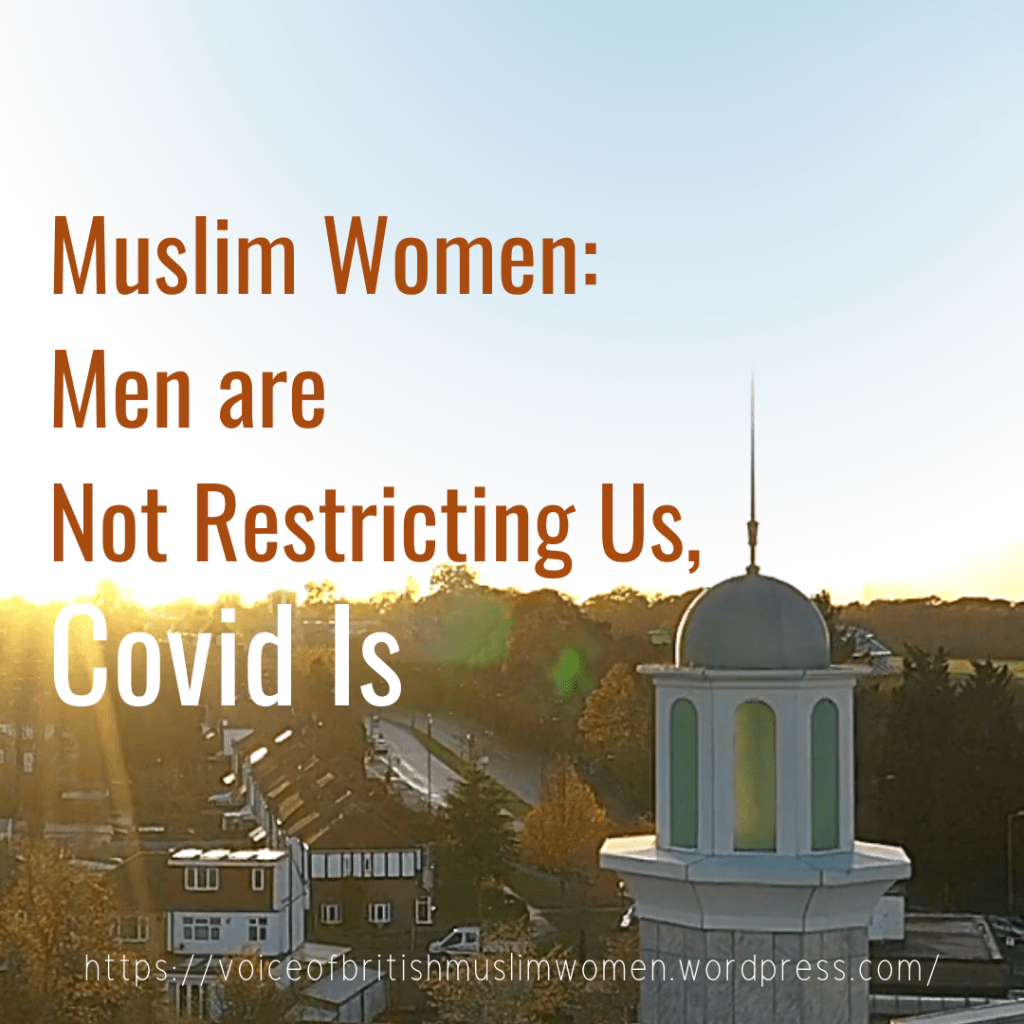
It was disheartening to say the least then, when I read headlines from the BBC and The Telegraph, claiming women were being denied rights by Muslim men or worse, by Islam, through the restriction of access to congregational Prayer in mosques.
Regrettably, Baitul Futuh Mosque, a mosque of my own faith community – the Ahmadiyya Muslim Community – was also ‘smeared’ in these articles. A mosque which I have attended since I was a child. A mosque where the space for females to Pray in congregation is just as large as the space for men, with additional facilities for women with children. A mosque where the women in the community have organised educational, spiritual, community outreach and sporting events, independent from the men. A mosque where there’s a dedicated women’s media team and their facilities are still open for them to carry out their work during COVID. A mosque where women feel safe and have freedom to practice their faith and develop other life skills.
Though such divisive, ill-informed articles are unsurprising, possibly more perplexing to those unfamiliar with the teachings of Islam, or women’s rights’ activists, were the empowered cries of thousands of affronted Ahmadi Muslim women on social media. They countered with the resounding message of: we are not oppressed, our voices will be heard over those who try to speak for us.
This brings us to the issue at hand: are women being denied rights of congregational Prayer in mosques? The answer sheds light on why thousands of Muslim women did not give a second thought to mosque COVID restrictions.
In Islam, men are not only expected to attend the mosque for the congregational Prayers 5 times a day, but it is a requirement of faith the Holy Qur’an outlines. Women also have every right to attend congregational Prayer. The key difference? They are afforded an additional right to Pray independently or in congregation in their homes, for which they gain blessings equal to men attending the mosque. It would be considered foolish to claim men and women are identical and, in its wisdom, Islam understands the needs of women differ. As such, they are not burdened with obligation in mosque-attendance in order for spiritual progress.
Unfortunately, faith and spirituality cannot be quantitatively measured, nor understood universally, especially by those who do not align themselves with faith. However, in a global pandemic where women have been stretched between facilitating remote learning, being primary caregivers, as well as work and other obligations, this serves as a perfect example of a time where Islam offers relief to women. They can rest assured knowing that their spiritual benefit won’t be compromised Praying at home, whereas men are not offered such luxury.
Moreover, it is important to note there is no difference in the physical act and sequence of Prayer, wherever performed. Therefore, when women realised that as a result of COVID guidelines, their access to congregational Prayer in a mosque was limited, they understood it. They understood that just as those who were offered the vaccine first were not taking away their rights, and just as the safety of healthcare workers and patients when attending medical appointments was priority, that their rights during a global pandemic were not being denied. Rather, Islam had already given them an advantage of spiritual benefit regardless of the place of their worship in a way that men had not.
Such articles have dampened the efforts of countless Muslim women in keeping their country safe. One purpose of congregational Prayer is to develop unity and sisterhood. Though we miss the physical space of the mosque, we have maintained that unity through regular local, regional and national virtual women’s events.
As the media continues to mute our experiences, portraying us helpless at the hands of men, we will continue to use our voices to ensure our experiences are heard. Most importantly, we will unwaveringly practice our faith in the safety of our homes, waiting for the day COVID ceases its restriction on our planet.
 Voice of British Muslim Women
Leave a comment