Iffat Mirza, Raynes Park
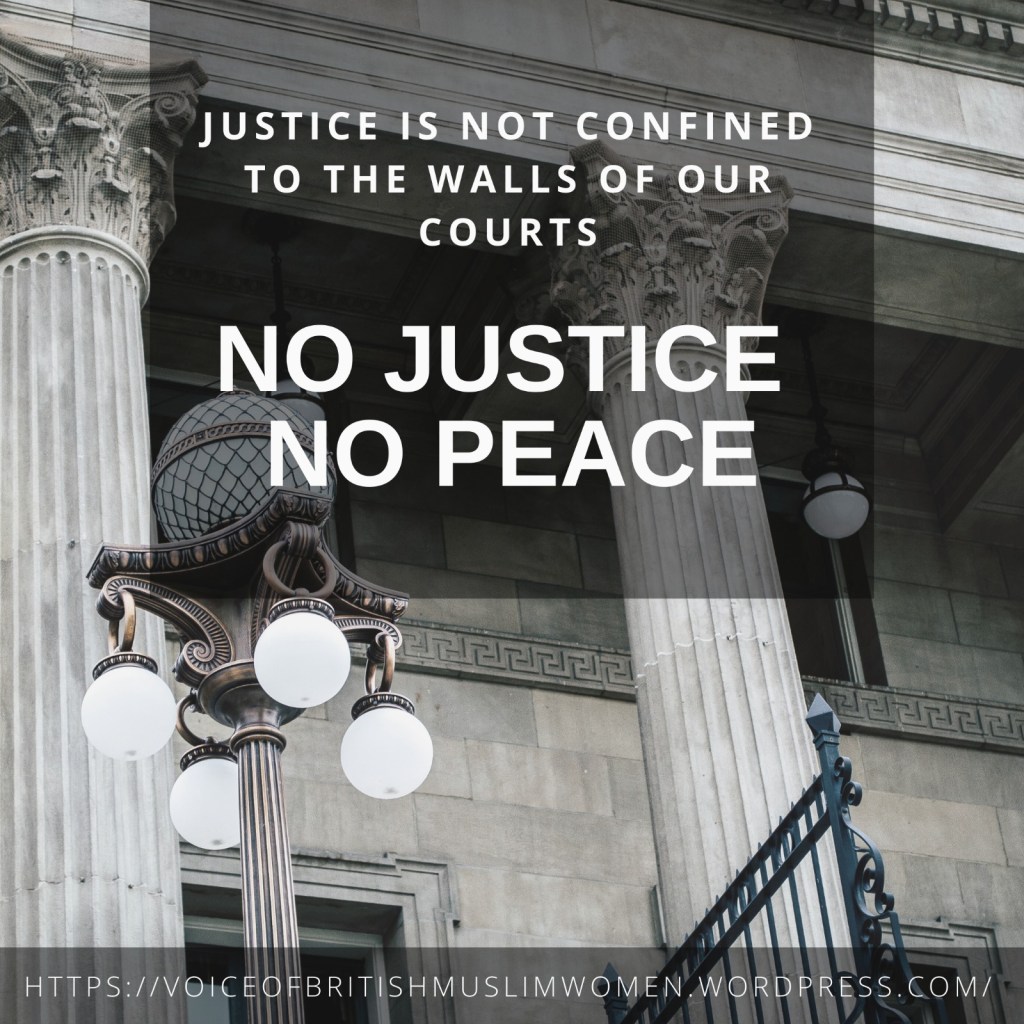
No Justice, No Peace.
These words have been at the forefront of African American civil rights movements since 1986 after the murder of Michael Griffith, and words that we continued to hear over the summer of 2020 as stories of police brutality and protests flooded news outlets.
Justice is no new concept. In Aristotle’s Nicomechean Ethics, he discusses the ways in which justice is necessary for the sake of a virtuous society. Indeed, different methods of justice have been tried and tested. Whether it was the Nuremberg Trials, the National Commission on Truth and Reconciliation in Chile, (and repeated by South Africa under Mandela), or the very image of the blind Lady Justice, the concept of justice has never been regarded as something trivial.
Despite being enshrined in the United Nations Universal Declaration of Human Rights in 1948, we still haven’t quite got the hang of it. Article 7 of the declaration proclaims, ‘All are equal before the law and are entitled without any discrimination to equal protection of the law.’ Though universally acclaimed to be the cornerstone of every society, few can truthfully claim they have treated all their citizens with justice.
Justice, it seems, pales in comparison to desires of power and wealth.
As an Ahmadi Muslim I believe true justice, can only ever be observed when it is done so following the principles and command of the Holy Qur’an: “O ye who believe! be strict in observing justice, and be witnesses for Allah, even though it be against yourselves or against parents and kindred. Whether he be rich or poor, Allah is more regardful of them both than you are. Therefore, follow not low desires so that you may be able to act equitably. And if you conceal the truth or evade it, then remember that Allah is well aware of what you do.”[1]
It seems we love ourselves more than we love justice, and consequently, more than we love others. If we truly wanted what was best for society, local or international, we would prefer to testify against our own selves in order to preserve peace and harmony.
Just as the words ‘No Justice, No Peace’ declare, it is impossible to uphold peace in a society which does not treat its citizens with absolute justice. Indeed, peace rests on the very foundation of justice. It is impossible to expect an oppressed people to consistently accept their subjugation, or to live in miserable conditions, as they see others around them bask in their freedom.
Perhaps the reason justice continues to be lacking is because we still have not understood the ways in which each human being is subject to it. That is not to say that we may all find ourselves, one day, pleading our case in the court of law – though we may. But rather it is something that we interact with every day. From the education we receive, to the food on our table, we can see how highly a society regards justice.
Each society, in its constitution has written the expectations and rights of its citizens. However, they have been far more intent on demanding the citizens of their duties rather than protecting their rights. If we looked at protecting the rights of others, we would see, in no time, society flourish. We would see that we are all in fact, ‘equal before the law’.
His Holiness Mirza Masroor Ahmad (may Allah be his Helper) stated, in regards to the ‘Innocent Lives Matter’ slogan, ‘It does not mean that those who commit low-level crimes or who may be forced into error due to the circumstances they have grown up in, where they have been denied opportunities and justice, are not deemed as innocent. In fact, if they are forced to commit such crimes to feed their families or to exist then they are very much innocent.’[2] Islam recognises that individual circumstances vary and which is why justice goes hand in hand with the truth.
Understanding that justice is something further a witch-hunt to punish those who break the law, is vital in creating a just society. Justice is not just an afterthought to the creation of law. Rather law is created to uphold justice. But it should be remembered that there is more to justice than law, just as his Holiness explains beautifully.
Justice is not only something that is enacted or upheld, but it is something that is observed. Justice is not confined to the walls of our courts. Justice is not punishment. It is truth. It is reconciliation. It infiltrates our every step, word, and action. It is not without reason that the Holy Qur’an teaches ‘be always just, that is nearer to righteousness.’[3] Above all, it is the way of a virtuous life and society.
[1] The Holy Qur’an Chapter 4 Verse 136, Translated by Maulwi Sher Ali Sahib
[2] https://www.reviewofreligions.org/24370/islam-black-lives-matter-guidance-of-the-khalifa/
[3] The Holy Qur’an Chapter 5 Verse 9, Translated by Maulwi Sher Ali Sahib
 Voice of British Muslim Women
Leave a comment