Nooresahar Ahmad, Hartlepool
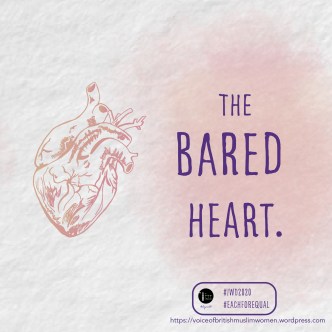
The author Debra Ginsberg said of motherhood that, “The human heart was not designed to beat outside the human body and yet, each child represented just that – a parent’s heart bared, beating forever outside its chest.”[1] To me, this is certainly true. When I spent a portion of my childhood unwell, it was my mother who I relied on, who had to share my pain and spend years without a full night’s sleep. I have seen first-hand that a child’s suffering can cause even more grief for a mother than it does for the child. If the heart that beats outside the body is in pain, the heart within the body aches in sympathy.
In truth, I still have a great reliance on my mother, and still depend on her for so much- it’s rare that I have to make a decision and don’t think to consult her first. This was embarrassingly exemplified a few weeks ago, when I had a doctor’s appointment about my asthma. At almost every question the nurse asked me – whether it was about how much I was coughing or which medication was effective – I turned to my mother to get her opinion before answering. (My mother, who had already asked in the waiting room if it was even necessary for her to attend the appointment, gave me a look as if to say ‘How should I know? They’re your lungs.’)
So, clearly, the task of motherhood is not one that ever ceases, no matter what age the child is. Perhaps the boundless sacrifice and endless care-giving required of mothers would be easier to comprehend if, as children often suppose, our mothers were all superheroes. Or mind readers. Or had glorious powers which gave them the ability to multi-task and problem solve and care for others without ever tiring. Yet, on the contrary, the Holy Qur’an describes mothers as bearing us “…in weakness upon weakness…” (31:15)[2]. Mothers have the same limitations as anyone else; yet go above and beyond their capacity for the sake of their children. I considered taking maternal figures from history to illustrate this point, and ample as they are, our own lives are already filled with examples which verify this. I have known women who studied their degree long-distance, as they were in an entirely different country raising their children. I have known women go through unimaginable pain during pregnancy. I have known women who spent the day looking after their children, and then stayed up during the night to study for university exams. The world is abundant and overflowing with the sacrifices and attention of women who do everything they can so that the heart that sits outside of their chest may continue to beat steadily.
This is, however, something Western countries, such as the UK and the US, seem to be forgetting. The cultures here “tend to be youth-centric, emphasizing attributes like individualism and independence. This relates back to the Protestant work ethic, which ties an individual’s value to his or her ability to work — something that diminishes in old age”[3]. Despite the fact our mothers are usually the people we owe the most to, as they grow older, they are becoming increasingly neglected. It is predicted that within the next decade, 2 million people over the age of 50 are projected to be lonely[4].
We can never replicate the sacrifice and pain that mothers put into giving birth to us, rearing us, praying for us, teaching us, playing with us – even if we are lucky enough to be able to support them when we reach adulthood. This doesn’t mean, of course, that we can’t spend our lives trying to give back the care and attention they selflessly provide for us. It is vital to remember the words of the Holy Prophet Muhammad (peace and blessings of Allah be on him)[5] when asked to whom a man should be kind. He replied, “Your mother”. When asked again, he said “Your mother”. When asked a third time, the reply was just the same – “Your mother”.
Copyright Lajna UK
[1] https://www.azquotes.com/quote/747477
[2] https://www.alislam.org/quran/31:15
[3] https://theweek.com/articles/462230/how-elderly-are-treated-around-world
[4] https://www.ageuk.org.uk/globalassets/age-uk/documents/reports-and-publications/later_life_uk_factsheet.pdf
[5] https://www.alislam.org/book/pathway-to-paradise/womens-issues/

 Voice of British Muslim Women
Leave a comment