Nooresahar Ahmad, Hartlepool
“…whosoever killed a person… it shall be as if he had killed all mankind; and whoso gave life to one, it shall be as if he had given life to all mankind…” – Holy Qur’an Chapter 5, Verse 33.[1]
What has always interested me about this Quranic verse is the way in which it gives a single human life the same import as the whole of mankind. To me, this is an allusion to the nature of human relationships; due to their wide-ranging and complex style, death can sever connections between a multitude of people. Life, on the other hand, can implement and restore these connections.
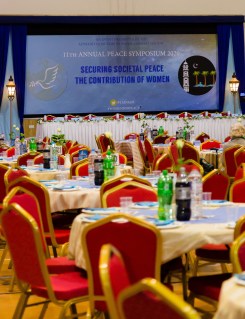
In today’s digital age, the scope of these connections has increased, but it can sometimes feel as though, instead of becoming closer, we’re drifting apart. As scenes of injustice, war and natural disaster play on our phone screens, an odd sense of disconnect and despair is created. It was then not only fitting, but beneficial, that the theme of this year’s Lajna UK Peace Symposium was the role women play in ‘Establishing Societal Peace’, as we try to navigate how to connect and promote peace in our communities.
The Lajna Peace Symposium is a truly unique event- organised by Ahmadi Muslim women, for all women- which this year took place on Saturday 25th January at the Baitul Futuh Mosque. The evening consisted of five female speakers, from a range of backgrounds and faiths, celebrating with the exclusively female attendees about the important role we have in bringing our society closer to peace.
The first speaker was Professor Karen Sanders, who discussed the importance of mastering our communication skills in order to foster peace in society- by utilising our body language, tone and empathy and by improving our ability to listen.
Alice Coulilaby, international programmes officer at Peace Direct, also spoke. From her work in areas of conflict, such as Somalia and the Central African Republic, Miss Coulilaby came to realise that from country to country, it is women who choose to mediate conflict and bring people together. Indeed, attempts at peace lasted longer when women were involved, than when they were not.
Lieutenant Commander Suzanne Lynch of the Royal Navy then emphasised the importance of the female presence in situations where conflict is to be discouraged and peace promoted. As women, Lieutenant Commander Lynch explained, we can bridge some divides that our male counterparts cannot, and it is the difference in our ability to empathise and communicate which make our influence so valuable.
The fourth speaker of the night was Shoshana Clark, CEO of Turquoise Mountains, from whom we heard the story of Samira Khan, an Afghani woman who played a vital role in promoting Afghan arts & culture, that were previously disappearing due to conflict, thus benefiting the Afghanistan economy.
All speakers delivered compelling discussion, but it was the keynote address, delivered by Dr Fariha Khan, President of the Ahmadiyya Muslim Women’s Association UK, which illuminated what societal peace means from an Islamic viewpoint. Every society, Dr Khan explained, starts from within the home. Islamic thought puts great emphasis on this- the key to which is placed in the woman’s hand, hence the Hadith, “Paradise lies at the feet of mothers”[2]. Key Islamic values which lay the foundation for societal peace were highlighted. These included the education of women (the worldwide literacy rate of Ahmadi girls being 99%[3]), the importance of justice (such as the prohibition of racial discrimination by the Prophet Muhammad, peace and blessing of Allah be on him[4]) and the endeavour to find inner peace (in the remembrance of Allah, as is stated in the Holy Qur’an[5]). The speech finished with a message in the same vein as that of all previous speakers: women have the capability and strengths to lead the way to achieve peace.
Peace, a clear priority of all the women in attendance at the Symposium, has been an objective of the Ahmadiyya Muslim Association since its inception. Today, Ahmadi Muslims continue to follow the example of our founder, The Promised Messiah, His Holiness Mirza Ghulam Ahmad (peace be on him). “It is our principle to have sympathy” he wrote, “for the whole of mankind.”[6]
[1] https://www.alislam.org/quran/5:33
[2] https://www.alislam.org/book/pathway-to-paradise/womens-issues/
[3] https://lajna.org.uk/ahmadi-muslim-women-initiate-the-conversation-on-the-role-of-women-in-establishing-societal-peace/
[4] https://www.alislam.org/book/book-religious-knowledge/life-holy-prophet-muhammad/farewell-pilgrimage-sermon-mount/
[5] https://www.alislam.org/quran/13:29
[6] https://www.alislam.org/library/books/Essence-4.pdf (p. 291)
 Voice of British Muslim Women
Leave a comment