Iffat Mirza, Raynes Park
As a child, being a Muslim in the West meant seeing my friends gasp as I told them Christmas is just an ordinary day for me. It meant explaining to my friends that I’m content with not receiving presents at Christmas. Then I grew up and I realised that’s probably the most trivial of my experiences as a Muslim in the West.
I then started wearing a headscarf to school, and whilst I was lucky that I was not subject to relentless bullying, it was certainly every now and then the butt of a joke. I then realised that as a Muslim in the West, I am in fact different. For any fourteen-year-old this can be quite daunting. At this age we will do anything to fit in and be like the others. I knew that this would never be possible for me, so instead of shying away, I consciously decided to embrace my difference. I did not want to submit to any taunts and as a result feel that I had betrayed my faith. Understanding that I was wearing the headscarf not just because my parents had told me to but because in Allah the Almighty’s instructions to do so, I was being protected from the dangers of the world, my confidence grew. Whilst the advertising of the cosmetics industry was telling me I had to be beautiful on the outside in order to achieve confidence and happiness, Islam taught me that by covering it, my inner beauty would shine brighter.
Embracing Islam in my predominantly atheist school meant that in every act and every word, people would know that I was Muslim. This was not by chanting ‘Allahu Akbar’ at any given opportunity as people may believe Muslims like to do. No. It was offering my teachers a seat when no one else would because it was the Holy Prophet (may the peace and blessings of Allah be upon him) who stated “Acquire knowledge and for the sake of knowledge acquire dignity and peace of mind; and be humble and respectful towards your teacher.”[1] It was volunteering to help in the school’s events because it was the Holy Qur’an that taught me ‘show kindness to parents, and to kindred, and orphans, and the needy, and to the neighbour that is a kinsman and the neighbour that is a stranger, and the companion by your side, and the wayfarer, and those whom your right hands possess.’[2] And it was always trying to be an honest friend for my peers, because it was the Holy Prophet (may the peace and blessings of Allah be upon him) who taught ‘It is characteristic of the believers that they should share each other’s tribulations, the same as an aching head makes the whole body ache.’[3]
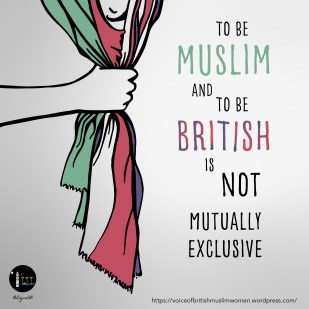
Suddenly everything that made me different and subject to potential ridicule made me a contributing member of the school body. I realised that as much as the Western media would like to hypnotise people into believing that Islam is fundamentally incompatible with Western values, it was only because of my Islamic values that I was integrated into the school and wider community. I did not have to betray my faith in order to prove my Britishness, rather I embraced it and, at least to myself, proved that to be Muslim and to be British is not mutually exclusive.
That is not to say it has always been sunshine and roses. I am no stranger to suspicious looks (or even questions!) but being a Muslim in the West has taught me that my loyalties need not be divided at all. On the contrary, Islam teaches that love of one’s nation is a part of one’s faith. Indeed, as a I read the Promised Messiah’s (peace be on him) book A Gift for the Queen, written on the occasion of Queen Victoria’s diamond jubilee, I truly saw how a humble person from a village in Northern India had so much regard for a queen from a faraway land and the amount of respect that he showed, not only to her but also her government. As someone who is studying a lot of post-colonial literature, I was amazed by the rather unique voice that actually praised the ruling government as it was the peaceful and respectful thing to do. The very short but profound book was filled with love and prayers for the British government and proves to be immensely resonant event today for someone like me, who is an immigrant living under the British Government. It taught me that integration and loyalty to our nation is by no means to leave behind our faith or loyalty to Allah. Indeed, if more Muslims and non-Muslims understood this, we could certainly work towards a peaceful future where communities live side by side in perfect harmony. I may be an optimist, but I believe it is possible.
[1] https://www.alislam.org/library/books/Wisdom-of-Holy-Prophet.pdf page 85
[2] Holy Qur’an translated by Maulwi Sher Ali Sahib (ra) [4:37]
[3] https://www.alislam.org/library/books/Wisdom-of-Holy-Prophet.pdf page 17
 Voice of British Muslim Women
Leave a comment